The Nairobi Solution: Ch.4
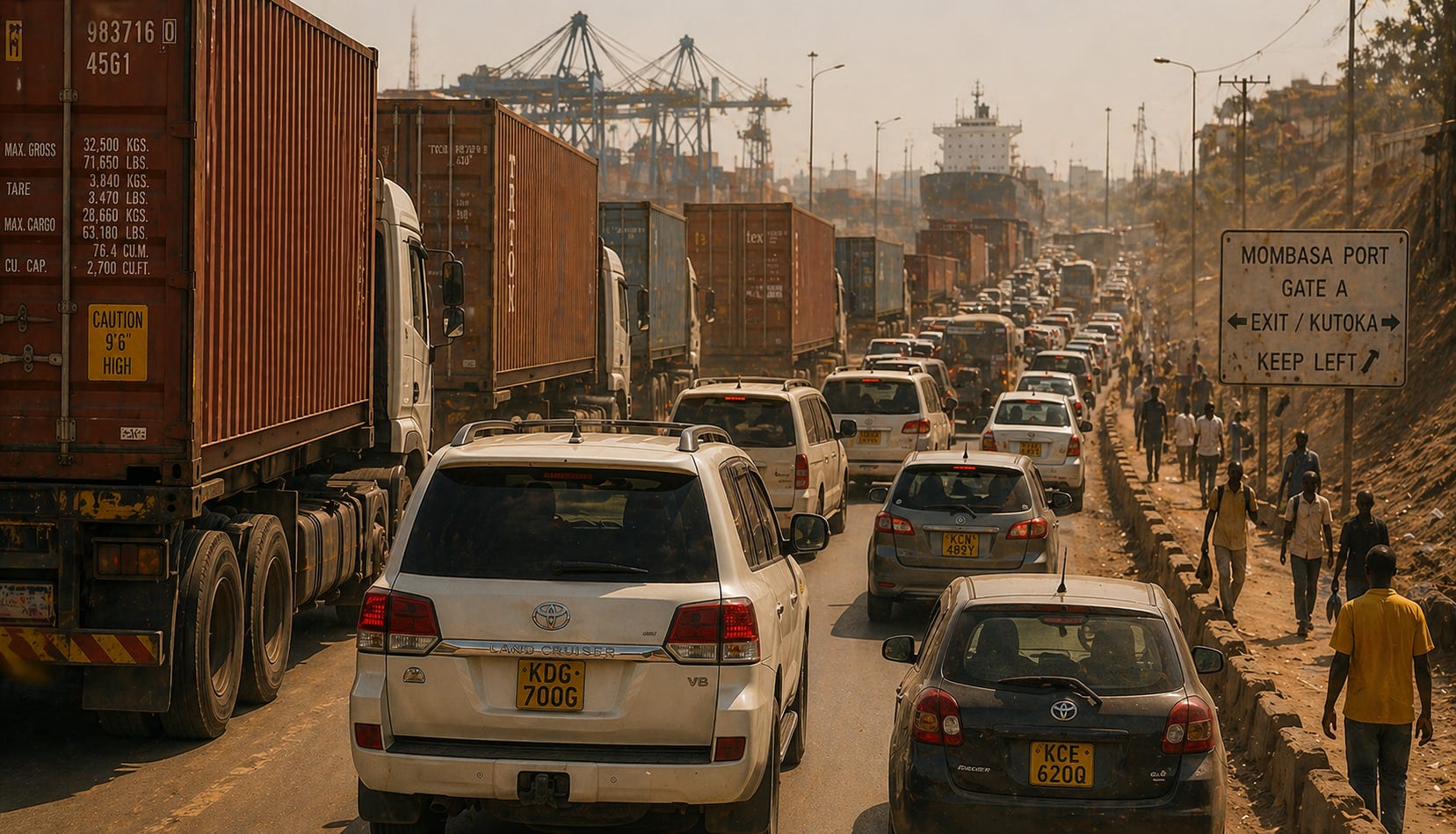
So much for ‘remote control’ Erik thought as their Landcruiser forced its way onto the crowded road leaving Mombasa port.
Erik looked out from behind the tinted glass window at the snarl of container trucks, scooters and taxis grinding up the hill and out of sight. Erik and Claire would exit for the airport in 10km to fly back to Nairobi, but these trucks would continue their journey for up to 1,000km as they fanned out across East Africa delivering their goods. Mombasa Port was the main port serving 140 million Africans across Kenya, Uganda, Rwanda and Southern Sudan. It was the most important port on the East Coast of Africa and the starting terminus for the East Africa Rail project.
They had just met again with the Kenyan Port Authority to try and bring the rail line into the port so containers could be loaded directly from the ship to the intermodal rail cars. The Port Authority and their engineers kept saying it wasn’t possible. The containers would need to be trucked a short distance out of the port and up the nearby hill to a larger railyard. This meant the trucks and their containers would have to drive through the incessant traffic jam outside the port gates. The same traffic they were stuck in right now.
Claire was looking out her window in the back of the Landcruiser. She was dressed well, with nice shoes and sunglasses perched on her head. She had nice perfume.
“It’s too bad about the port, but maybe it’s manageable. Not ideal, but manageable,” Erik said to break the silence.
“Easy for you to say. You only have to answer to your crazy hedge fund boss. I have to write this up in a report for the directors back in D.C and explain why the whole starting point of the railway has moved and why this wasn’t known from the beginning and disclosed in the initial proposal.”
“Well it’s Africa. They are going to have to get used to it. Nothing goes like in the proposal.”
Erik thought back to Belway Capital’s own initial expectation of what they were getting in to with Turkana Trust.
Erik had done his initial review of the bank’s financials and surmised that if they could invest at 0.5x book value the risk/reward looked good. Their key concern had been the bank’s large project loan to the East Africa Railway SPV to fund the early years of the railway’s construction. The project was to build a transformational railway from Mombasa Port all the way to Kampala, Uganda over 1,100 km away. The railway was to be completed in stages with Stage 1 running 480km from Mombasa to Nairobi.
For the bank it was an attractive loan. Erik understood why they had made it. The loan paid 12% in US$’s. Yes, it was high-risk to build a new railroad in Africa, but there were mitigating circumstances. The main one being that the IFC had invested equity into the SPV. This meant strict governance and project management. The second benefit of having the IFC on board was their deep pockets. The IFC wasn’t likely to quit funding a high profile, transformational railroad in Africa if it turned out there were a few unexpected delays and it needed a little more money.
To Erik and Dwight it seemed a safe bet that the IFC would keep funding the project, and eventually the railway would be completed. Plus, there was a highly capable company like China Eastern overseeing the construction.
Once the railroad was operational it would be easy for East Africa Railway to get an infrastructure loan at 7% to pay back the loan from Turkana Trust Bank. This one large loan repayment would reduce the stress on the bank, improve the capital ratios and rerate the bank back to 1.5x book. The trade for Dwight and Erik was to get through this uncertain patch in the middle while the rail project wasn’t yet complete. Then later after the bank was derisked, Belway Capital would sell the bank to a private equity fund.
As part of the due diligence they had both flown down to Nairobi to visit the bank and meet its CEO, Rajiv Desai. Erik learned that despite being worth hundreds of millions of dollars Dwight liked to save money and fly coach. In Nairobi they had had many pleasant meetings and dinners with Rajiv and his team of bank managers. Rajiv was always smiling and answering their questions, but was obviously stressed.
Erik empathised with Rajiv. It must be a lot of pressure to be the third generation to run your family bank then be the one who was in danger of losing it all. And Rajiv must be thinking of all the turmoil over the years which is father and grandfather had successfully navigated. But, now when it was his turn he had failed and had to sell a large stake to a London hedge fund.
As part of their due diligence Erik and Dwight had also taken a drive out to Turkana County in the Western part of Kenya where the bank had most of its branches and deposit base. It was a desolate and poor area of Kenya. The bank was named after the large Turkana Lake. It wasn’t a prosperous area, but there were no other banks competing in there so it was a profitable place to raise deposits. It had a niche.
The challenge of Turkana was that it didn’t have much industry. While driving around Turkana they observed a new wind farm being installed. They also noticed the trucks for a UK oil company which had made an oil discovery. Unfortunately, the oil production would be years away. Otherwise, there wasn’t much going on.
Back in Nairobi they had met Claire, the attractive French CEO of East Africa Rail. Claire was part of the IFC’s strict project management. Her explanation of the extensive due diligence which had gone into the project, as well as the ongoing controls and frequent reporting back to the IFC gave Erik and Dwight confidence about the bank’s East Africa Rail exposure.
In the end they had done the deal and Dwight had wired $20 million for a 44% stake in Turkana Trust Bank which made him the largest shareholder. Rajiv’s family was diluted down from 60% ownership to 34%. Several other wealthy Kenyans owned the remaining 22%. Erik was appointed to the board to represent Belway Capital and be Dwight’s eyes and ears. It involved flying down to Kenya every other month to attend meetings.
The deal had gone well for the first year. Rajiv ran the bank and Erik attended the board meetings. Erik’s job was to monitor the East Africa Rail loan like a hawk. Track laying was on schedule. But then had come the time to order the locomotives and the railway wagons from CERS. Then there had been the shock invoice from China Eastern which had necessitated the trip to Shanghai. Then the call with Dwight followed by an unpleasant trip to Nairobi to deliver news to Rajiv that he was no longer running his family bank and in fact would have no role whatsoever in the daily operations. And then explaining to Rajiv that he Erik, who had never run a bank before, would be moving to Nairobi to be the new CEO. He felt bad for Rajiv, but Rajiv had failed in running the bank, misled them about the credit guarantee letter and needed to be cut.
Which was why he was in this Landcruiser outside Mombasa port, sitting next to Claire, stuck behind a container truck.
“So, tell me. Your French. How did you end up in Africa? How did you become the CEO of an African railway?”
Claire looked out the window and could see it was going to be a long, stop and go ride to the airport. They had a lot of time to kill. She let out a small sigh.
“I grew up in Biarritz. It’s on the Atlantic Coast near Spain. From there I went to business school at Aix-Marseilles. It’s not a great school in France, but I earned good grades and managed to land an entry level job at SocGen in Paris. I worked my way up through the investment banking division and worked on a lot of infrastructure finance deals. I was quite good at it. Then after the financial crisis I was laid off from SocGen as part of a restructuring.
“I sympathise. Same thing happened to me. Not investment banking, but a fund I was working for also shut down. It was a hard time to get a job. What did you do?”
“Travelled a bit. Lived off my savings. Like you said, it was a hard time to find a job. All the French banks were trying to reduce risk. Two years later I managed to get a consulting job, which I did for a while, also related to infrastructure. But I hated it.”
“How did you end up at the IFC?”
“A friend of mine was working in the their distressed debt division. She was always working on Africa deals and found out they needed someone to analyse African infrastructure deals. The IFC had been financing projects across Africa, but were running into lots of problems. The projects always looked great on paper with promises to ‘transform’ the continent, but the execution phase would inevitably run into delays, corruption and cost overruns. They realised they were good at funding projects, but not good at executing them. The IFC was losing tens of millions on these projects and decided to conduct a review of their whole approach to infrastructure investment. Everything became more rigorous with strict processes. And the other thing the IFC realised was these big infrastructure projects were being run by managers with social aid backgrounds and no finance experience. So they made changes to the department. They wanted people who had worked on big deals for investment banks. Hence me.”
“And then what? You went to work for the IFC, and somewhere along the way they said, ‘Hey, can you move to Kenya and run the East Africa Rail project?’”
“Yes. Basically. For them East Africa Rail was a big ‘transformational’ project.” Claire said holding up her hands to make air quotes. ‘So rather than wait for it to go bad and then afterwards bring in Western management to fix it, they decided to start with a Western CEO in the first place.”
“And now you are living by yourself in Nairobi running a railroad.” Erik probed.
“Not that my personal life is any of your business. But yes.”
“And when you finish this is the goal to get a job back at a bank in Paris?”
“Again, none of your business. But yes.”
“Thank you. We are working a lot together so it’s just nice to know a little bit about who you are. I’d tell you my own story but it’s long and depressing. The conclusion is the same though. We both need this to work.”
Erik looked out the window again at the traffic and the people walking on the side of the road. There was no sidewalk and they were mostly wearing T-shirts and shorts with flip flops. Some were carrying things. Some were balance things on their heads. Erik wondered how far they would have to walk this afternoon to get where they were going.
His mind continued to drift and he thought of the truck drivers and what their next 20 days would be like as they slowly made their way West to the interior of the continent. Long days and nights. Police check stops. Bandits. Long waits at the border crossings. And the cost of it all. He’d read it cost the same to sail a container the 10,000 km from Shanghai to Mombasa as it cost to get it the next 1,000 km to Uganda. That was what the railway was meant to fix. Or at least help fix.
Claire needed the project to work. Erik needed the project to work. And for the first time Erik realised how much the people out there on the road needed it to work too.


