

I want to share a free piece of advice.
It’s going to seem obvious.
But learning it and appreciating it was expensive for me.
Here it is….
“Entrepreneurs who have made billions of dollars growing a business most likely know more about that business than you do.”
And here is how I came to that realisation.
In 2009 I was a punk trader at a hedge fund. Funny how I see myself that way now, when at the time I thought I was brilliant.
I traded a lot and was shorting Las Vegas casinos; Las Vegas Sands in particular. Las Vegas Sands was caught in an especially bad position. The GFC hit while they were in the midst of building Marina Bay Sands in Singapore. Marina Bay Sands was a grand project and the most expensive casino ever built. It was expected to cost US$6 bn by the time it was completed in 2010. No one could imagine how such an expensive casino would ever recover its costs in the midst of a global recession. A recession which was expected to last for years.
Because I was a high paying customer who traded too much JP Morgan invited me to a private event to meet LVS CEO, Sheldon Adelson. It was an evening meeting and I remember walking down the strip from the Wynn to the Venetian. I remember that as I was walking I couldn’t help but be impressed by the size of the Venetian, and how impressive it was in the evening light.
Our group met next to a private elevator in the lobby and were taken up to one of the top floors to Sheldon’s board room. Then we all sat around a big conference room table waiting for Sheldon to arrive. I remember looking around at all the long only fund managers and thinking it was weird to be there because I was the only one betting on the firm’s collapse. Really, I shouldn’t have been there. After 5 minutes Sheldon came in and wheeled himself to the head of the table.
What he said stuck with me forever.
Three forever points.
#1 Sheldon explaining that the skeptics about Asian gaming demand would be wrong and that the problem would not be too much supply, but whether there would be enough.
This is the lesson of imagination. It’s a John Burbank lesson too. Most people lack imagination. The great entrepreneurs and money makers have imagination and aren’t afraid to have nobody agree with them.
#2 That he had $1 billion sitting in Treasuries and there was no way this company he had spent decades building was going to go bust.
You realise that for entrepreneurs companies are like their children. They think about these companies all day. They think about them more than you do. And they will fight for them. Elon talks like this too.
Sheldon remarked that his private bankers had advised him they didn’t think he should invest more money into LVS. Which elicited ‘Forever takeaway #3’.
#3 You should not take advice from people who have made less than you. Take advice from other successful people.
Sheldon was not going to take advice from a private banker who had never built anything in life on what to do with his money.
Afterwards, on the walk back to the Wynn I called our trader, even though it was late, and told him to cover the LVS short first thing in the morning and to flip it around and go long.
History would show Sheldon was right about everything. Marina Bay Sands would be the most profitable casino ever. And still is. Turns out Sheldon knew a lot more about the gaming business than a punk hedge fund trader.
Why do I bring this up?
Because I see the same thing happening with Larry Ellison at Oracle. Everyone naysaying him and predicting how Oracle is going to blow itself up.
Here is some representative market wisdom of the day. From Twitter; where all great investment insights come from.
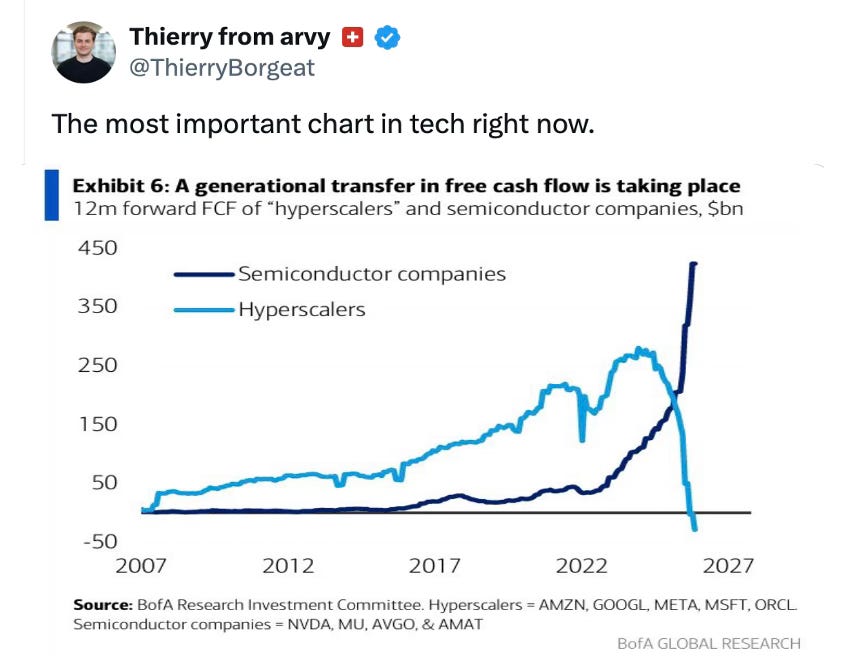
I don’t know who ‘Thierry’ is, but he goes on to say:
Here’s what history says about this chart: Companies that burn cash on capex booms rarely earn back their cost of capital. Telecoms, 1999. Shale, 2014. The sellers: supplier windfalls at the top of a capex cycle are peak earnings, not new baselines. The customers’ spending discipline eventually returns. Ask Cisco. A generational transfer of cash flow is a generational transfer of risk. Both lines on this chart are priced as if only the good half is true.
The typical thing. ‘Hyperscaler’ capex is like shale oil or telecoms in 1999. Total malinvestment.
Which is why we go back to my free piece of advice.
Larry Ellison didn’t get to be one of the wealthiest people in the world for nothing. He knows more about the cloud business than you.
I want to share three things he sees, but isn’t saying explicitly, because at the end of the day he is a wolf.
#1 AI accelerates corporate lock-in.
‘Cloud’ is such a nice, fluffy image for what is actually a deadly transition for corporations. Think about it. Companies outsource their life organs to an oligopoly of 4 cloud companies. They no longer operate their data bases, file storage, data analysis, software computing, web hosting, cybersecurity, identity management and on, and on. Companies have become shells. There are all the services you see on the outside, but the heart of the business is run by AWS, GCP, Azure or OCI. Once a company has ‘transitioned to the cloud’ which they announce with a happy press release, the value extraction screws begin to turn.
Think about it. Now without the core cloud services these businesses cannot even turn on the lights. In my view investors don’t have a full appreciation of the complexity and breadth of the ‘cloud’ offering. I wrote about this in Appreciating AWS.
Once a company has ‘transitioned to the cloud’ it is pretty much impossible to move back. As part of the ‘synergies’ they usually get rid of all the expensive IT staff who knew how to run the backend servers and network.
AI is gas on the fire for this trend.
Think of Cloud 1.0 as a company outsourcing its heart and lungs. In Cloud 2.0 with AI they outsource their brain. In Cloud 2.0 all of the firm’s intelligence and data is wired into the cloud offering. The firm cannot literally even think without AWS, GCP, Azure or OCI.
Larry Ellison sees this. He sees where this is going and why he is frantically throwing every dollar he can as fast as he can to bludgeon Oracle into the top cloud offerings. Because this is it. You are either in the game, at the table, over the next few years when all the corporate brains gets wired up, or you are out forever.
That’s what he sees, but he cannot come out and say it like that. He can’t say ‘Once you move to Oracle Cloud I own you.’ He has to talk about ‘customer synergies’ and ‘service offerings’. Remember, the guy didn’t get to where he is because he’s an idiot. He knows exactly what he is doing.
#2 AI is synergistic to the other Cloud Offerings
Another misperception is this term ‘hyperscaler’. It implies this explosion in cloud revenues is coming from 3 mega AI companies (Anthropic, OpenAI, xAI) and is mostly AI model training. To investors this seems one dimensional and risky. Too reliant on a few big companies with questionable business models.
Drop the word ‘hyperscaler’. Go back to ‘cloud’.
Because what Larry sees and says, but nobody cares or appreciates yet, is that growth in AI, drives growth in all the other cloud offerings as well.
I want to show you this using data from our own AI project, Stevie. You never get the product level detail from the cloud companies so you don’t see how it works. But I am in it and see how my spend is growing across everything.
Back in July 2025 I was spending $24/month on an Open AI subscription, $18 on a Google Workspace account and $1/month for a web domain. Total $43/month.
One year later I am spending $55/month on my database, $21 on compute, $114 on AI subscriptions, $71 on AI API calls, $61 on email related tools (new Google Workspace account for Stevie and SendGrid), and $21$ for web domains and app hosting tools (Vercel). The total is $345/month. A +690% increase in 1 year.
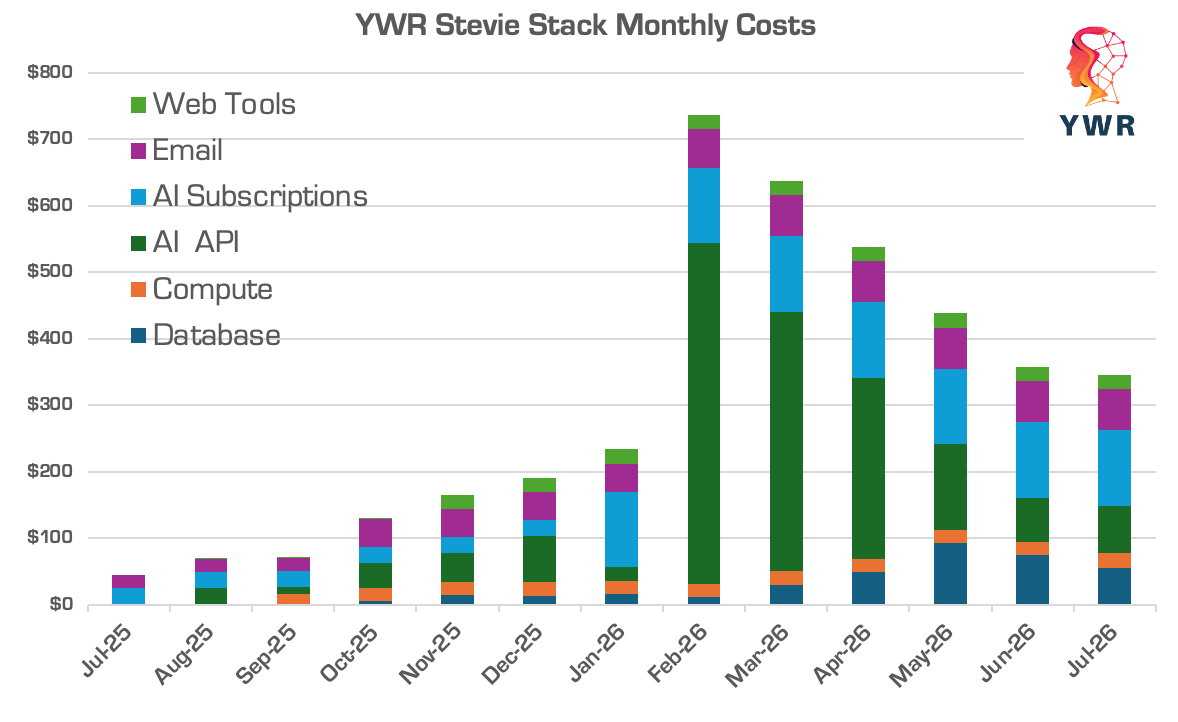
And here is the YWR version of what Larry sees. My database costs are rising hand in hand with my AI costs. From $0 (free tier) in July 2025 to now $55/month (and somehow $91 in May). Larry sees that AI goes hand in hand with higher data usage. This is a key realisation.
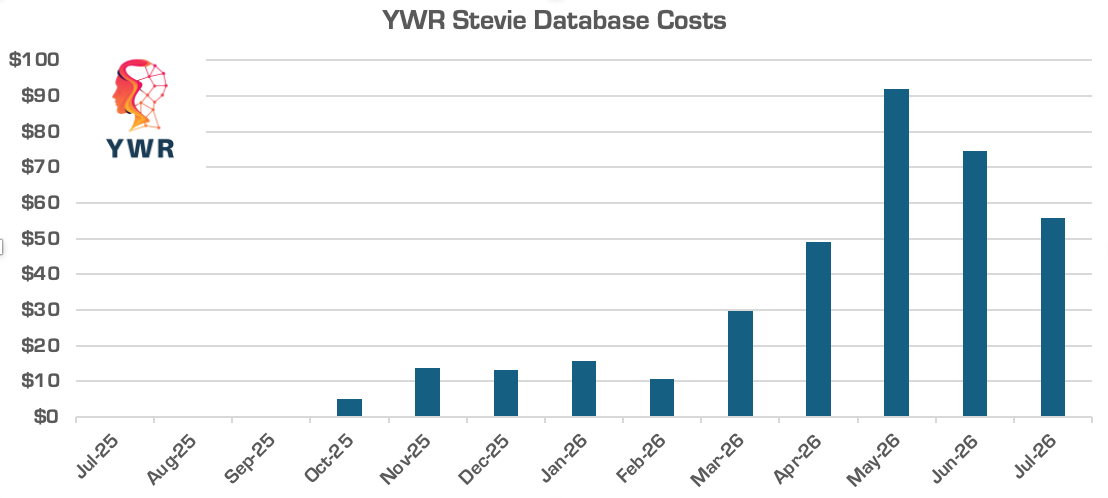
In fact I’d say the data base costs are steadier and more persistent than my AI costs which are starting to moderate. And I have a lot more cost optimisations I could do to my AI costs if I spent time on it.
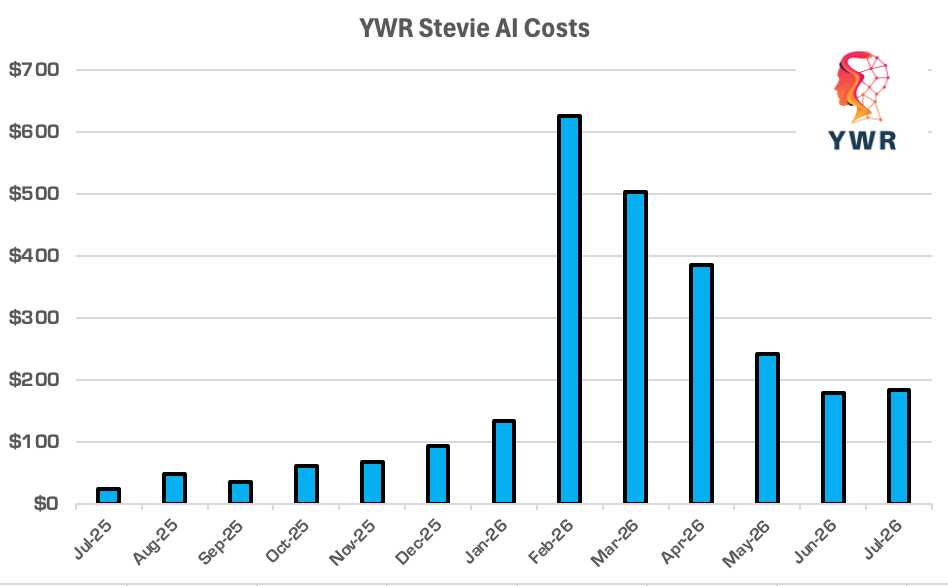
Note: the $600 spike in February was when I launched Stevie. Lots of people were trying it out and I had every API call running on the premium Opus model. Plus, I had a bug where Stevie was in a loop running continuous API calls. It was a panicky few weeks until I optimised the model usage and fixed the bug.
Everyone is focused on AI spend. The dirty secret is that even though I am using more and more AI, the revenue mix between AI and non AI services is steady at roughly 50%.
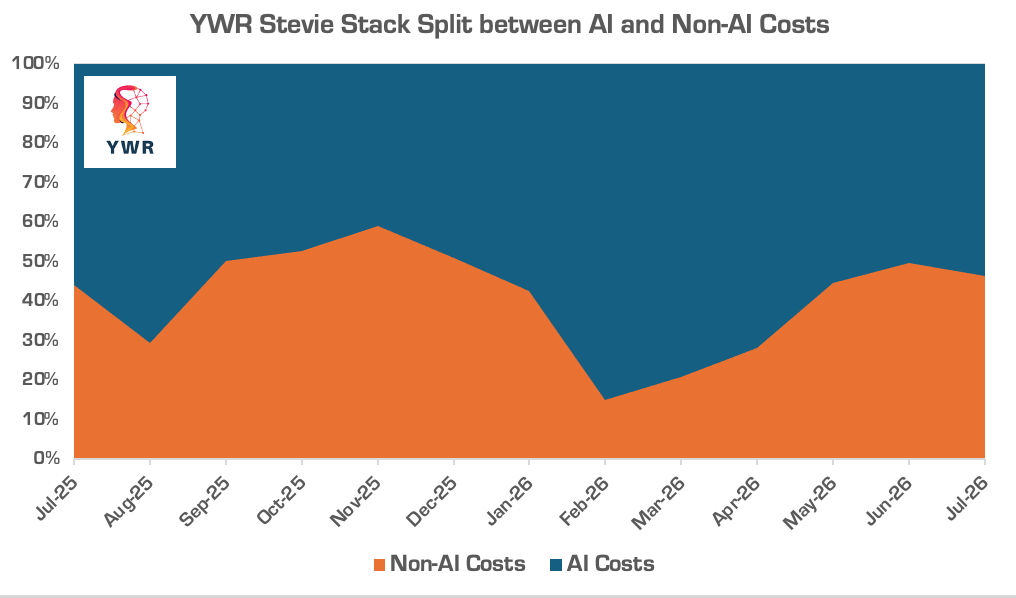
This is what the cloud companies see. When companies build out AI applications and use AI, they can’t help using all the other cloud services too. It’s a package deal.
It’s why revenue growth for the Big 3 clouds is accelerating. In the March quarter yoy growth was 35%. In June 2026 yoy growth was 43%.
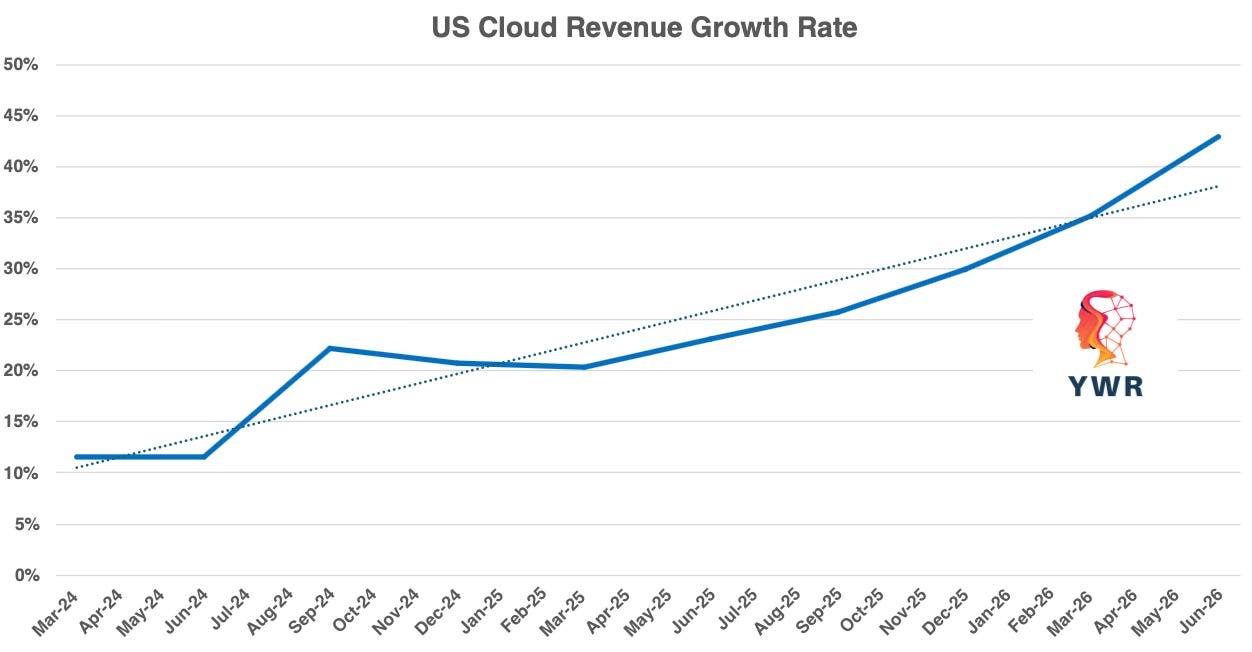
This is why they are spending the money.
The cloud companies see the lock-in. They see the network effects that AI spend drives spend of other clouds services and that from unimaginably high levels already, cloud revenues are accelerating further.
And once companies are in their cloud using AI there is no way out.
#3 The Cloud Business as a Life Insurance Company
When you value life insurance companies you often have to use ‘embedded value’. A life insurance contract starts out deeply cash flow negative. A 7% commission is paid up front to a sales person and then the life insurance company makes back the commission and earns its return over 10-20 years. Life insurance companies that are growing quickly are especially cash flow negative. So you can't put a current year P/E ratio on a 20 year life insurance contract which starts out negative and earns value over years.
Life insurance contracts are similar to what the cloud businesses are building. They are spending massive cash flows up front to lock in 6 year contracts where they will extract an all in 35% gross margin. And the 35% gross margin factors in the upfront costs and timing gaps where they are installing the GPU’s and not getting paid. They factor in everything (as best they can).
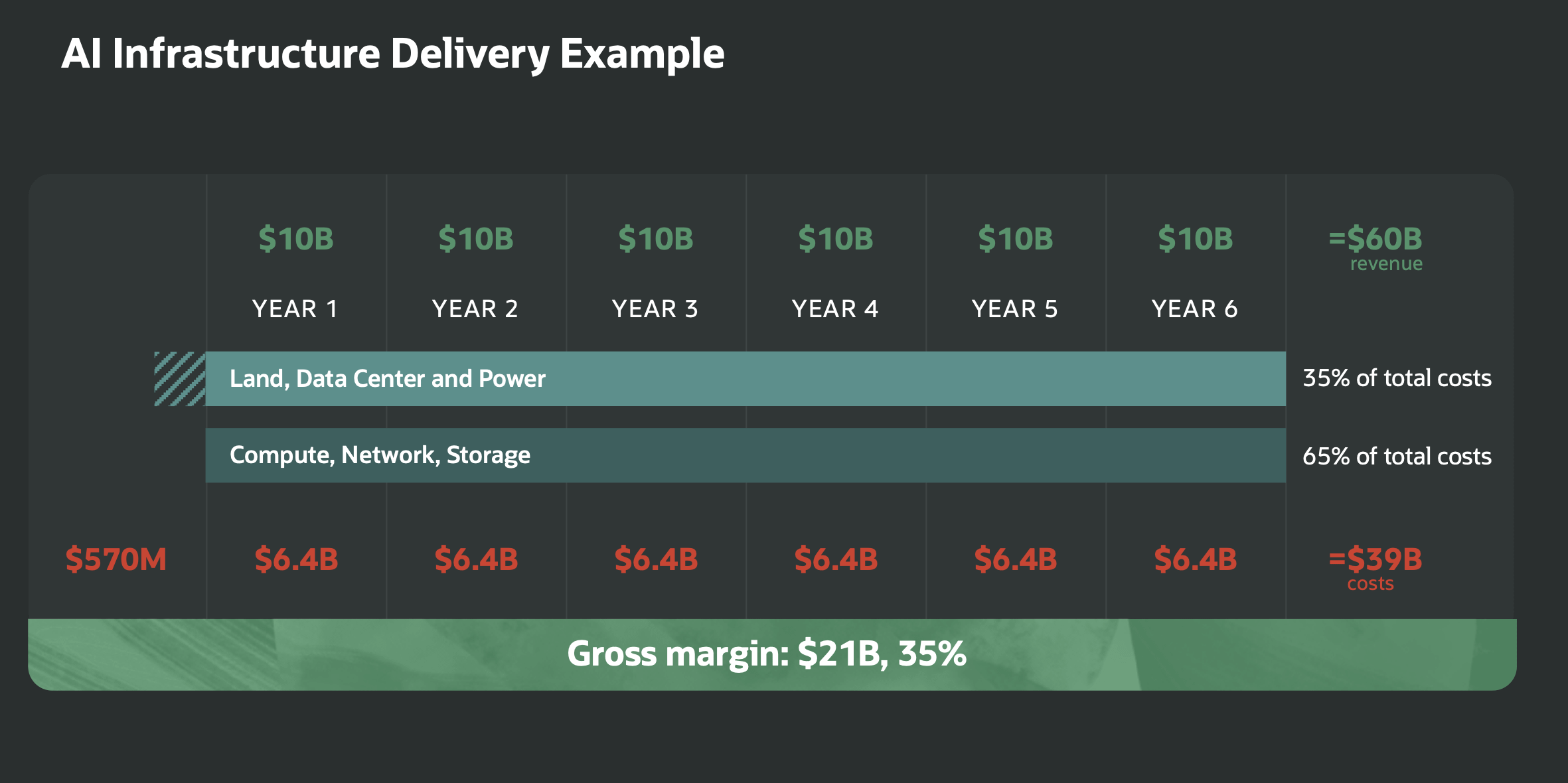
And why are Oracle, Google, AWS and Azure building all this incredibly expensive infrastructure? Because they are the only ones who can. That’s the opportunity. They are the only companies in the world with the cash flows, balance sheets and ratings to build infrastructure of this scale on a multi-year payback. And like an insurance company they are going to get paid back over years. Don’t worry, it’s all in the price.
Put it all together.
The market is worried Larry Ellison has over leveraged Oracle, is trying to expand too fast and might go bust.
That is the opportunity.
Trust that Larry knows this business better than you. And like Shelon, and like Elon, he did not come this far to have Oracle go bust. In fact if you listen to the Oracle Analyst Day presentations in October 2025 you can hear how much effort they are putting in to matching the costs and revenues of this historic AI build out. They are highly aware of their credit metrics, cash flow needs and revenue timing.
Oracle knows they need to be mindful of the balance sheet, but Larry also knows the time to strike is now. It is one of those rare times where you need to be massively aggressive. He needs to lock in as many companies as possible to the Oracle Cloud while the AI pie is up for grabs and there is an opening for Oracle to muscle in to the cloud oligopoly.
Larry knows either Oracle becomes a top AI cloud business, or it is a piece of database software which gets marginalised over time. It’s life or death.
He’s right to be doing what he’s doing.
He knows this business better than you or I or ‘Thierry from arvy’.
Oracle $400/share
I’ve tried modelling Oracle, but the reality is it’s a stab in the dark. Mostly you have to go off what they say. We can’t know the details and timing of these large revenue contracts and the associated data centre costs.
But here is what Oracle is guiding.
And it’s insane.
Revenues from $67 bn in the year ending May 2026 to $225 billion by May 2030 with a warning this might need to be revised higher.
The adjusted EPS grows from $6.85 in 2026 to $21 in 2030
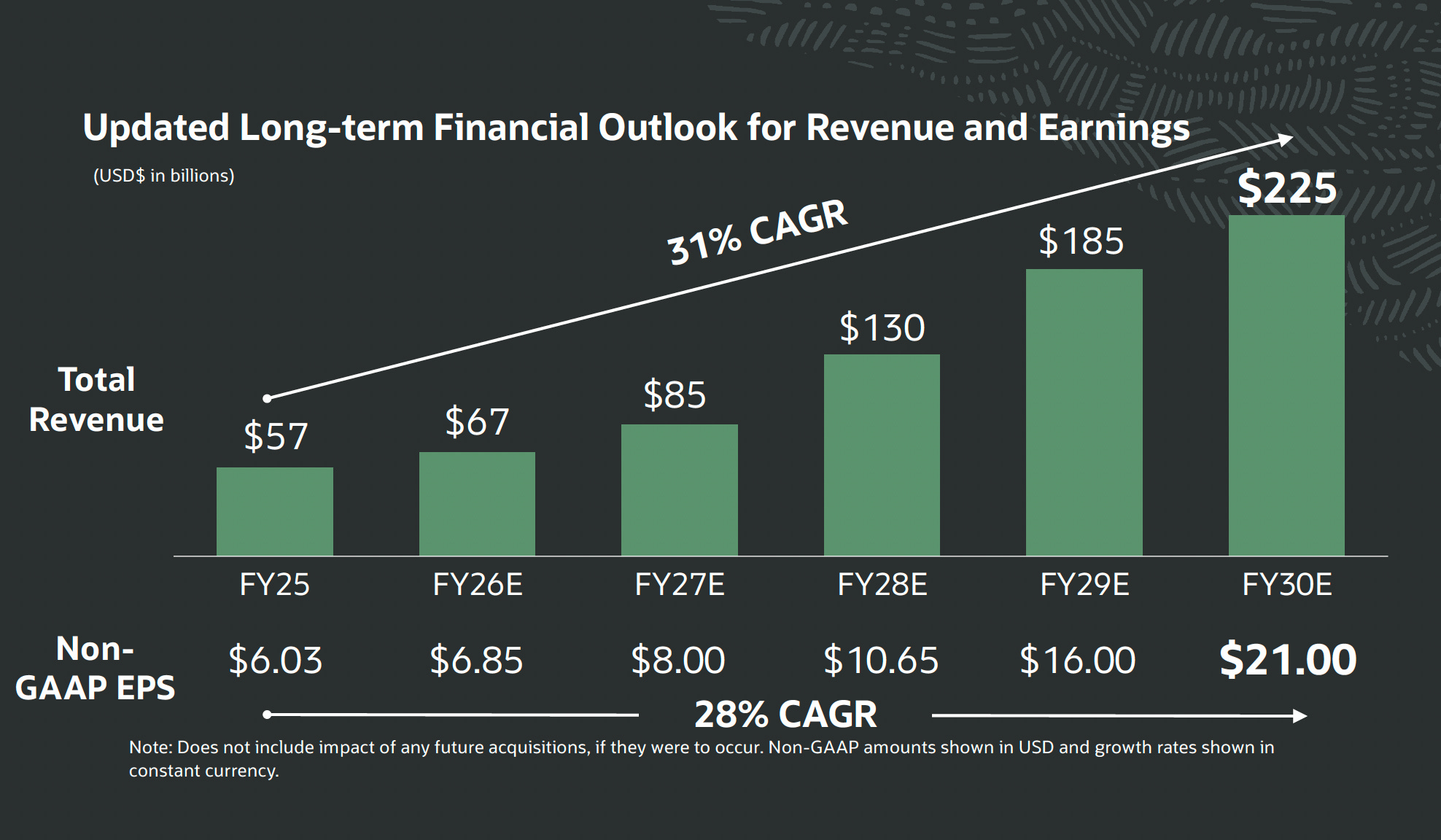
Can we all appreciate for a moment how incredible it is to have visibility on $158 billion in new revenues from signed contracts? It shows you how well Oracle is capturing the moment.
There are risks, the road will be volatile, and this is not financial advice, but I think if we look ahead two years Oracle could be trading at $400/share (+175%) or 20x the 2030 adjusted EPS.
2029 is key because (on my numbers*) the debt metrics should inflect sharply downwards. The capex moderates and the revenues increasingly come online. In 2029 I have capex declining from $80bn to $60bn with EBITDA growing from $51bn to $82bn. By 2030 Oracle is paying down debt. But yes, the next 2 years will be a roller coaster and there might not be much to calm the credit fears.
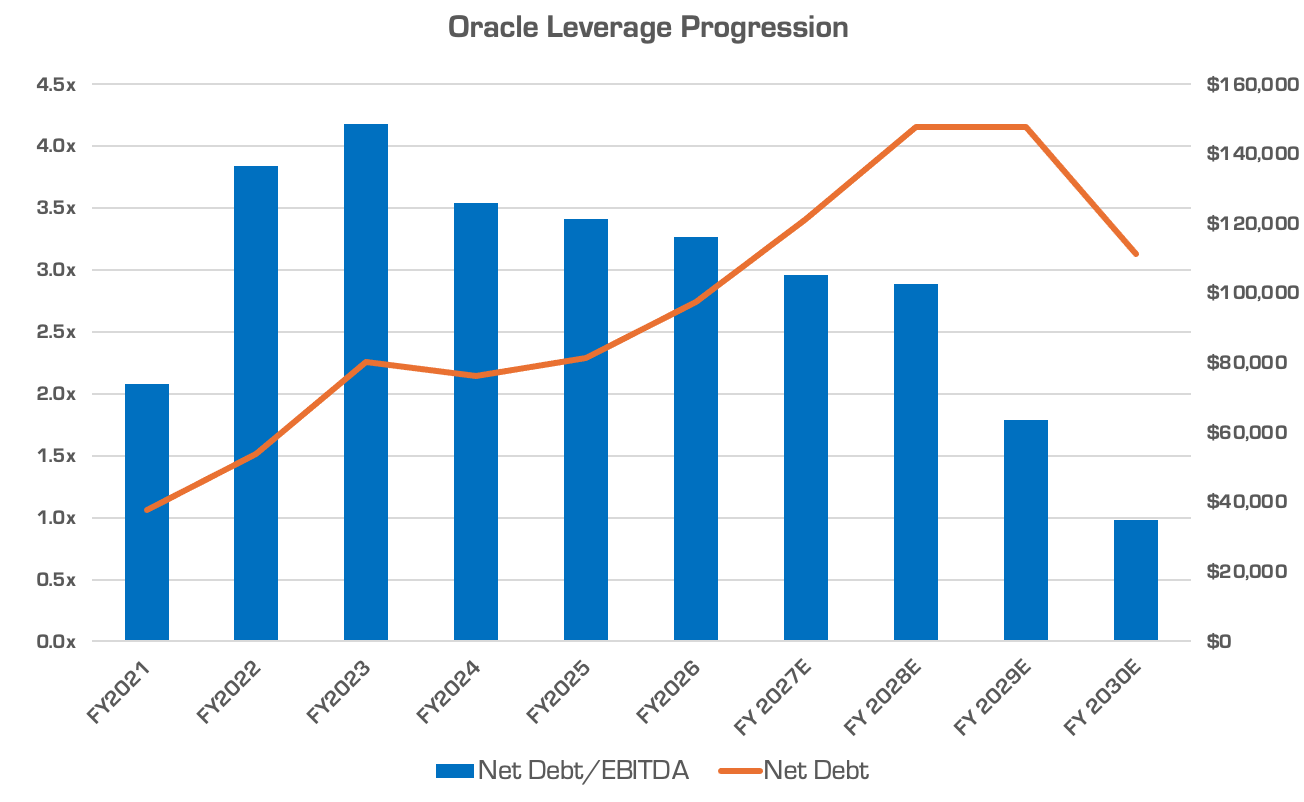
By late 2028 though investors should be able to see the revenues are real, the credit metrics are moderating and Oracle has muscled itself into an exclusive oligopoly. The company will be on track to earn $20/share and might even talk about share buybacks.
The financial stories will be about how ‘Larry did it again.’
And wouldn’t it be nice to have make money on that?
Below is a link to my Oracle model and the Oracle Analyst Day presentations.
