

It looks crowded. Semis and memory.
Let’s analyse the publicly disclosed equity positions at 445 funds with over $3.9 trillion in assets.
We loop through the Top 20 positions at every fund managing > $1 billion and count of which stocks keep showing up. This creates our list of the Top 21 Most consensus stocks. It’s 21 because I wanted 20 different companies, but the hedge funds always own both share classes of Alphabet.
Note: The full dataset with every fund’s Top 20 positions is available at the bottom of the post.
So what do we see when we compare June 8 with January 31?
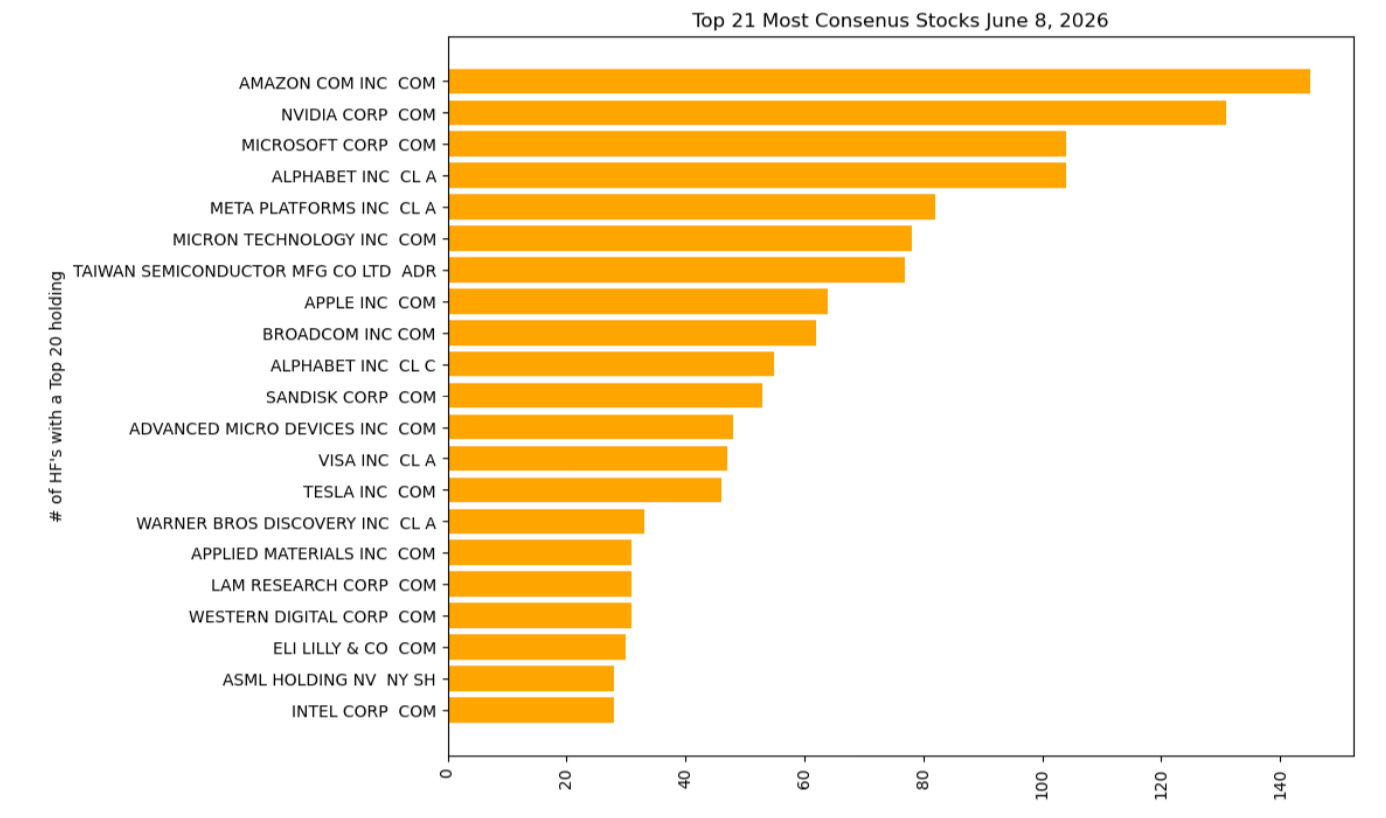
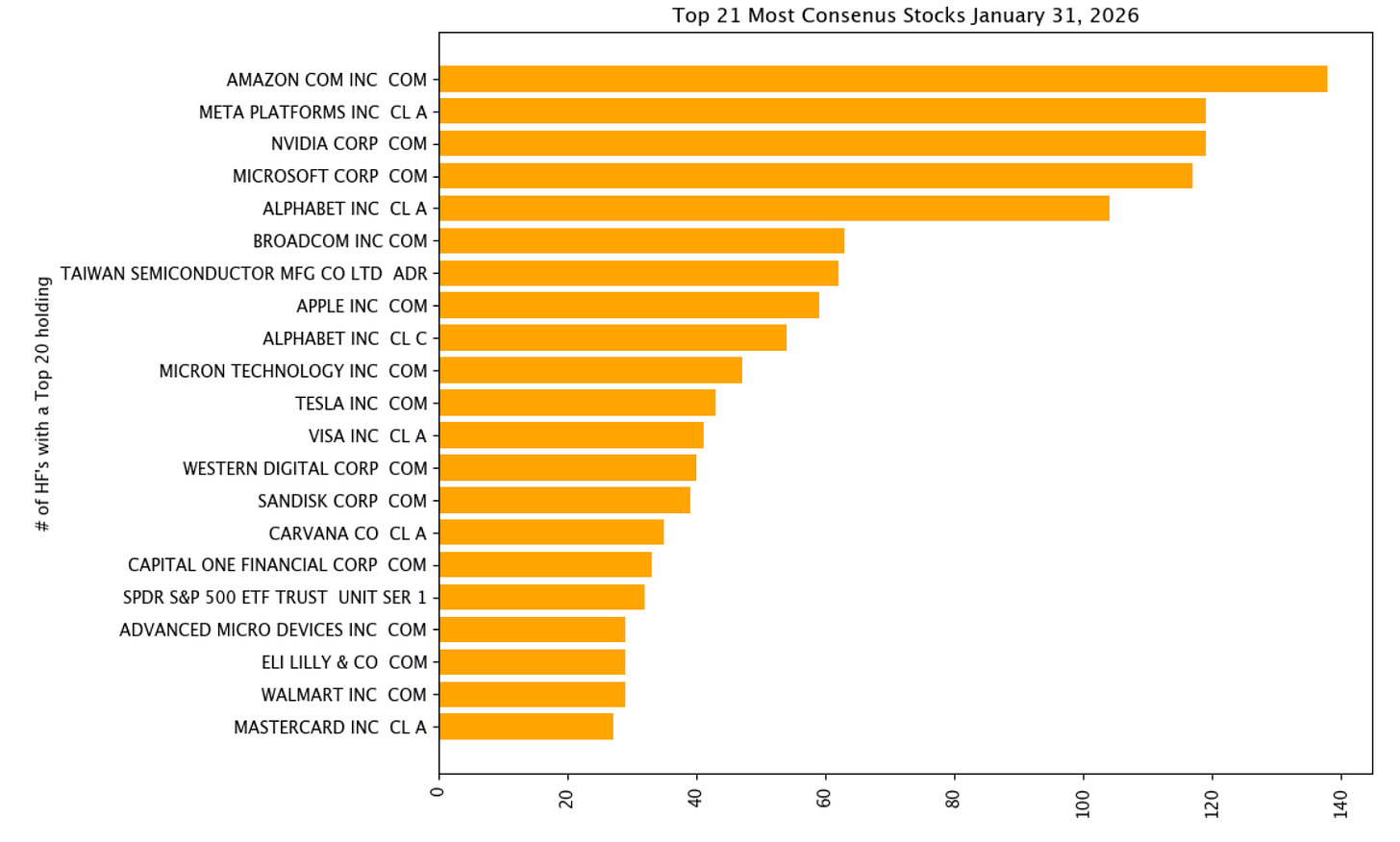
Amazon is still the most consensus holding.
Nvidia keeps moving up the ranks. It’s up from #3rd most popular holding to second. I’m sure it will beat Amazon soon to be the #1. It used to be that Nvidia was a considered to be a ‘bubble’. Now funds are increasingly comfortable that the earnings are ‘sustainable’.
Meta went from #2 to 5. Investors are nervous about Meta spending similar amounts as AWS or Azure on datacenters, but without a cloud business.
Apple, the steady eddy, no data centre builder is unchanged at #8.
Look how many semiconductor/hardware/memory names are in the Top 21. 11. Up from 7.
It’s incredible that 11 out of the most popular hedge fund stocks are the same theme.
In fact I would argue 17 of the 21 stocks are the same thing. Only Visa, Tesla, Warner Brothers, and Eli Lilly are not a Semi/AI/Datacenter play.
That’s actually quite incredible when you think about it.

No energy stocks, no banks, no GE Vernova, no Netflix, Spotify, ThermoFisher or Salesforce. All the software stocks gone. All the finance gone, except Visa. Mastercard is gone.
It’s a wipeout. Everything is AI.
Which is interesting because in our Global Factor Model analysis the best sectors in the world for earnings momentum are refining, and oil and gas. But the hedge funds are missing it.
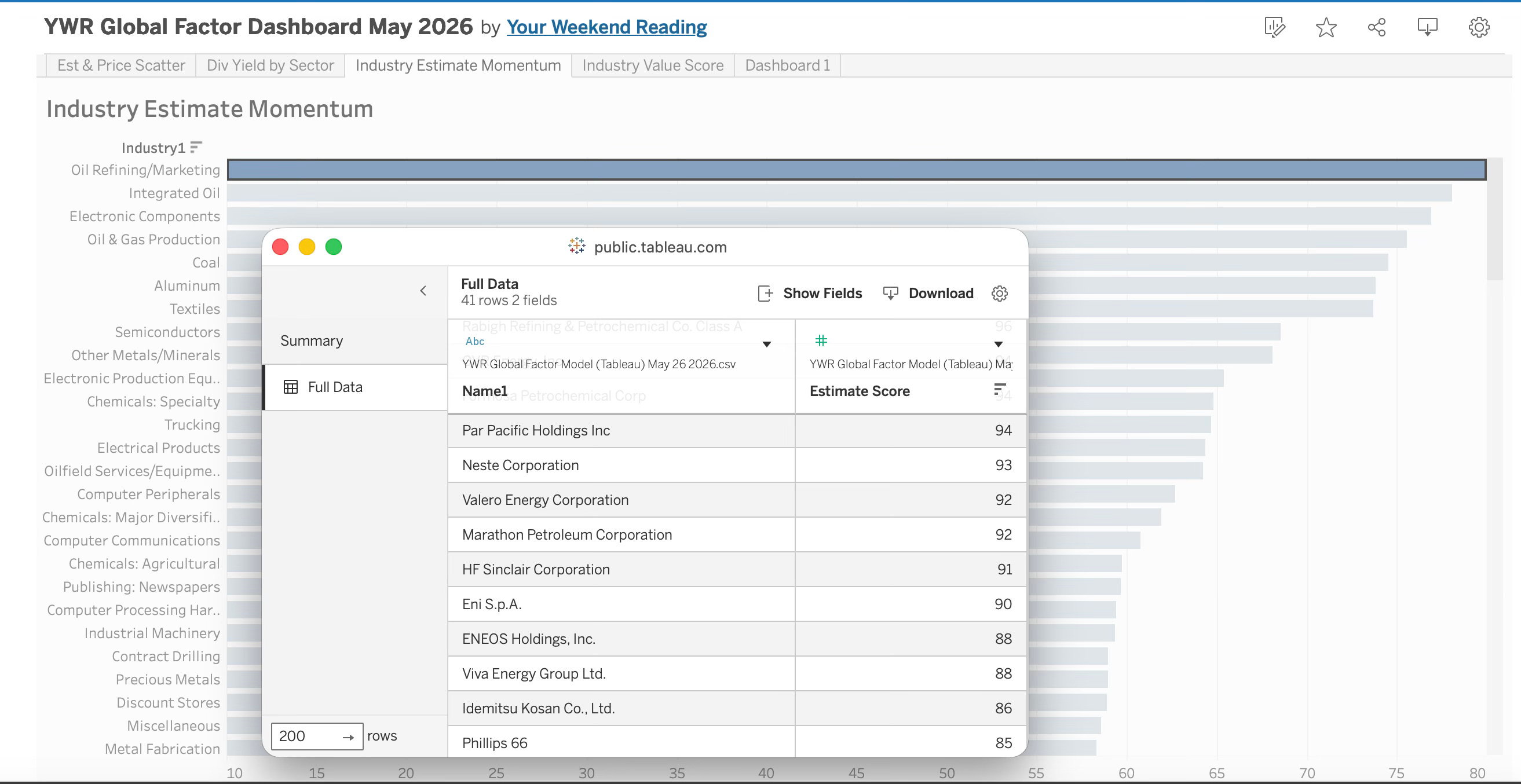
The only fund I see catching the refining wave is Kuppy at Praetorian Capital.
Most Consensus Funds
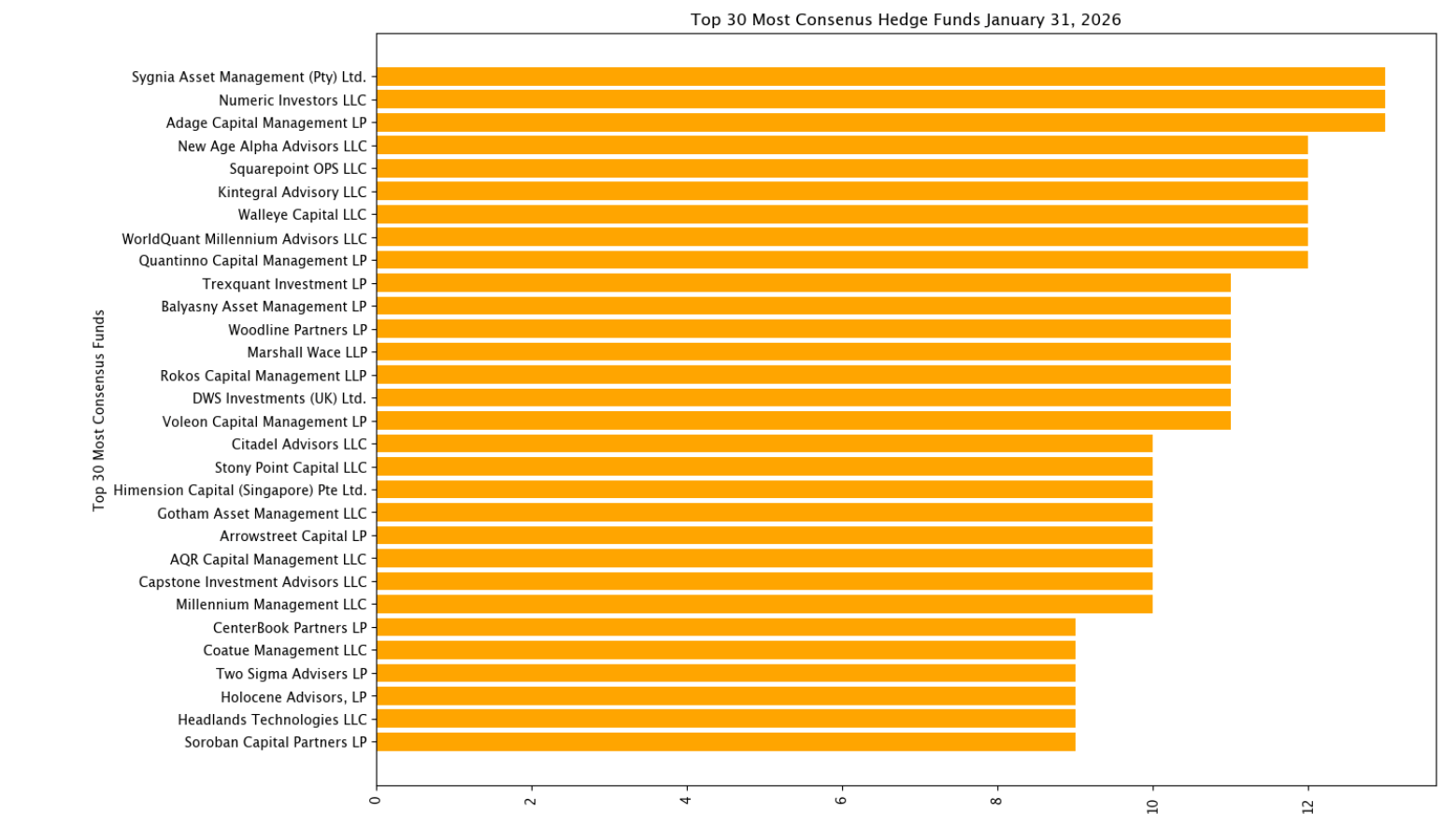
I also run a count of which funds have the biggest overlap between their Top 20 positions and the Top 21 most consensus stocks. These are the most consensus funds.
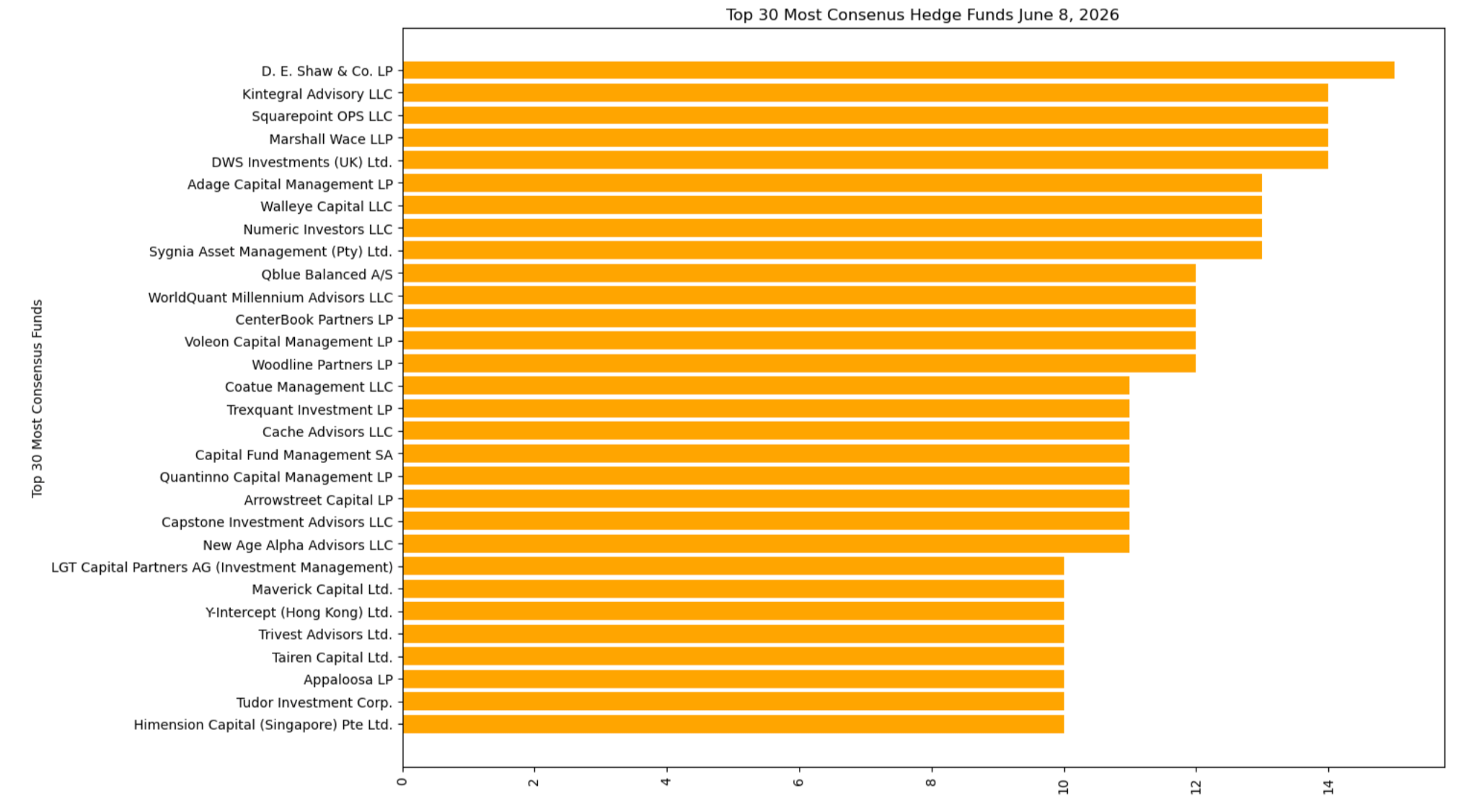
The names of the funds move around a little, but what I notice is the distribution of this chart has shifted to the right since January.
The extreme outlier used to be two funds each owning 13 of the 21 most consensus stocks. But now there is DE Shaw with 15, which is a record. And 3 stocks with 14 consensus positions. Interesting that Marshall Wace and SquarePoint, both big users of alpha capture systems, are at the top of the consensusness list.
Tons of alpha there.
Also the 30th most consensus fund used to own 9 consensus stocks, but that has shifted right to 10.
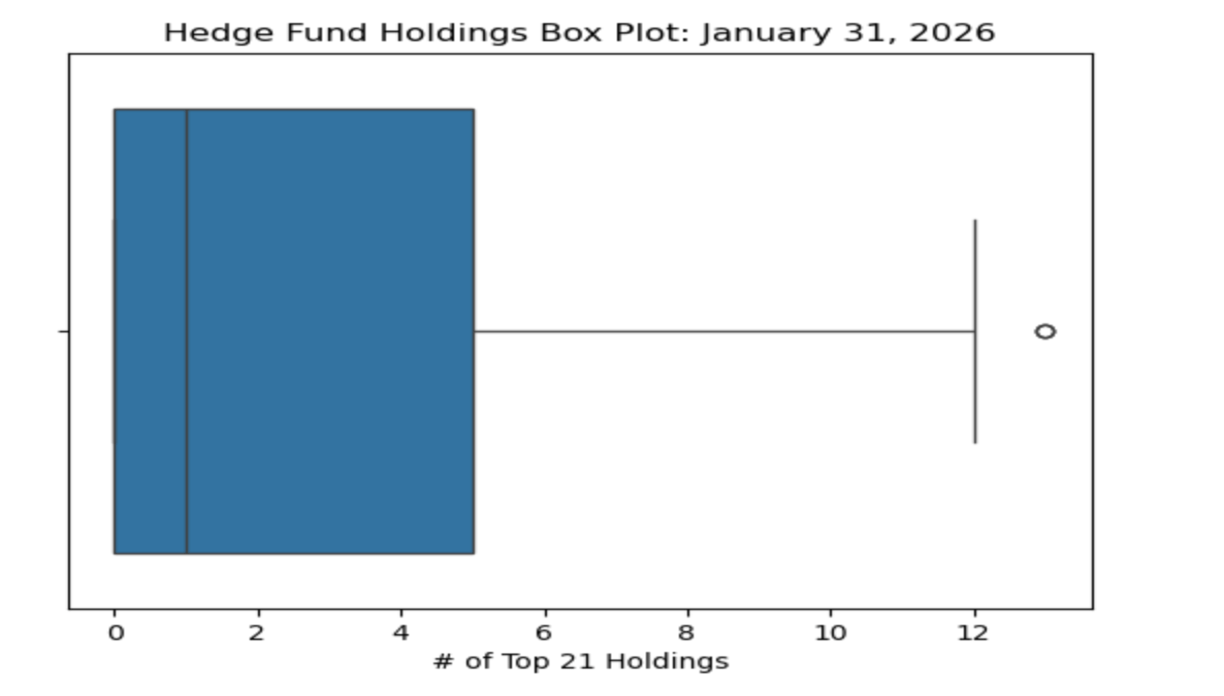
While it looks like the big funds are becoming more and more consensus (owning the same stocks as each other), the overall distribution hasn’t changed for the 445 funds. There are more just outliers in the right tail.
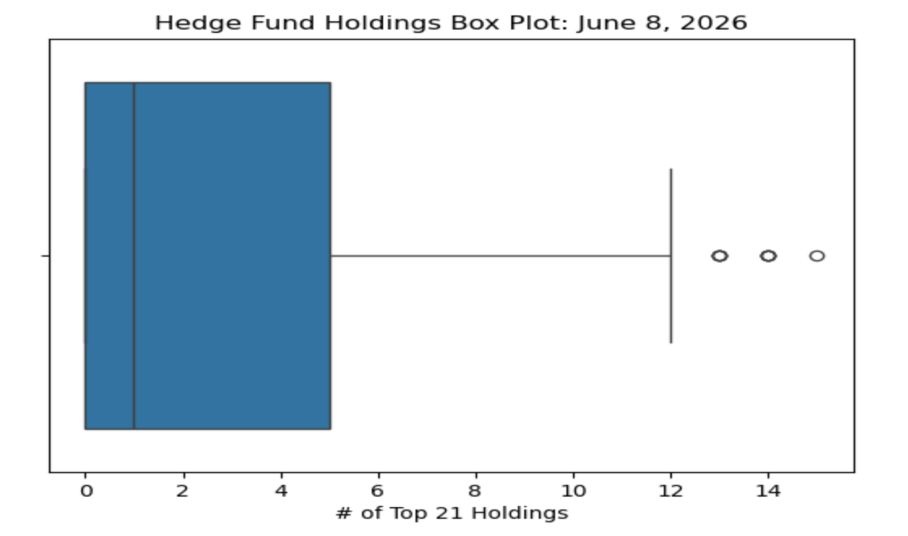
The box plot analysis shows the median is still 1 consensus stock holding for a fund, with 75% of funds having fewer than 5 consensus names.
The bunching into the same stocks is mostly with the bigger funds. The scatter plot below shows equity assets (y axis) and consensusness (x-axis).
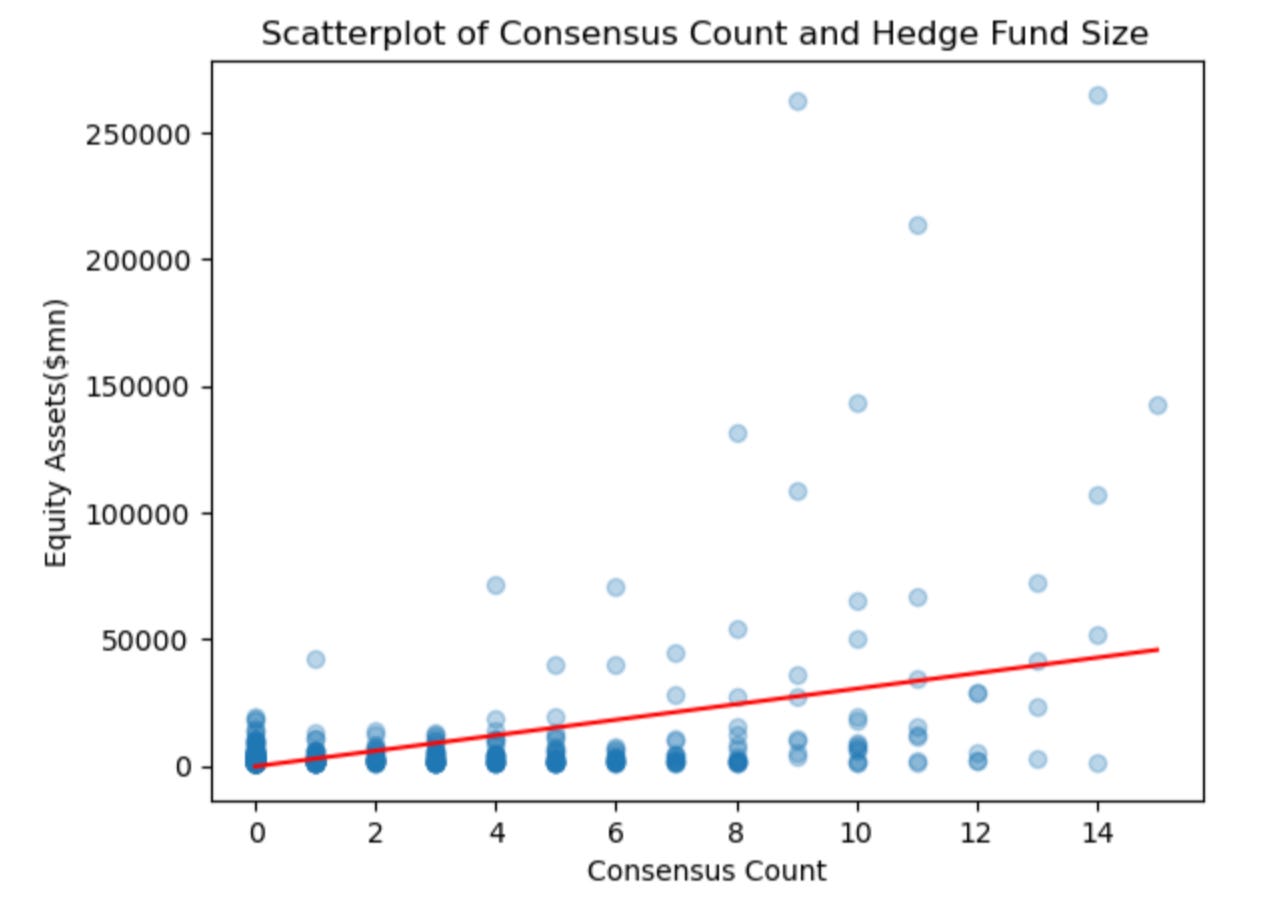
To summarise, we see the bigger funds concentrating more into the same names, and those names themselves are all the same thing.
Most consensus, non-consensus stocks.
We also loop through the top holdings of hedge funds which don’t own any of the Top 21 most consensus stocks, to see if there is anything they agree on.
The most consensus stock among non-consensus funds is Talen Energy, the utility which runs the Susquehanna nuclear power plant. Constellation Energy is also a nuclear power utility.
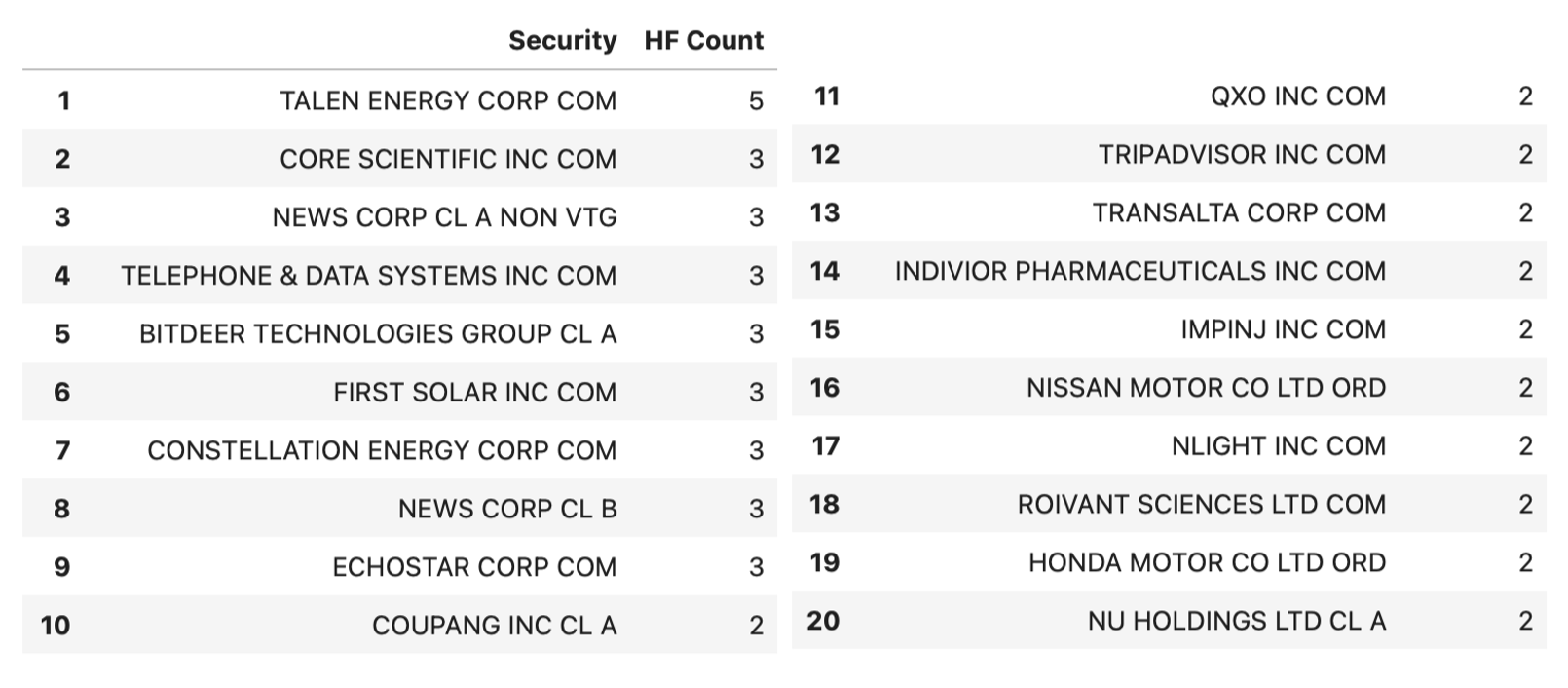
Nu Holdings is the digital challenger bank operating in Brazil and Mexico.
Fund of the Month
Farallon is our interesting fund of the month.
What do we see in their top 20? Let’s strip out all the usual AI derivatives and see what other plays they are making.
There is a lot of healthcare here. Revolution Medicines (Redwood City based cancer biotech). UnitedHealth Group (great trade). Bridgebio, Exelixis, Natera, Protagonist Therapeutics, Lantheus (radiology isotopes), Liquidia (inhaled therapies), Thermo Fisher(lab equipment), and Boston Scientific (medical devices).
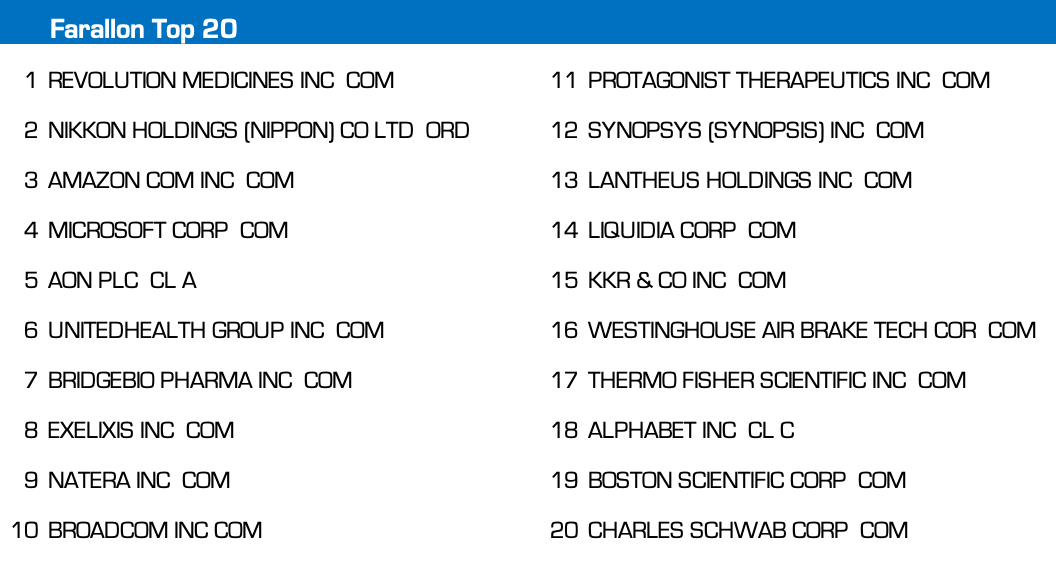
Does Farallon’s positioning tell us biotech is a backdoor AI beneficiary where AI accelerates drug development? And if drug development is going to accelerate, is the other way to play it the contract manufacturers like Wuxi AppTec (2359 HK)? The Foxconn of drug development.
Below is a link to the full dataset so you can explore the Top 20 equity positions for over 1,700 funds.
