

Why do stocks always outperform bonds?
Like for hundreds of years.
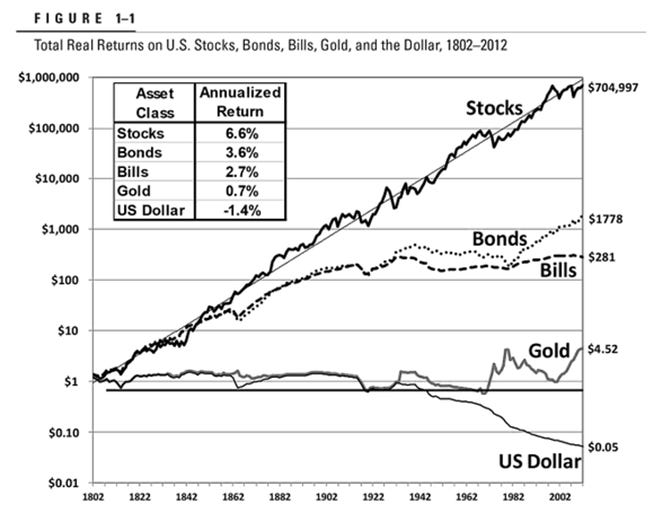
$1 invested in stocks in 1802 was worth over $700,000 by 2012 compared with $1,778 if invested in bonds.
That’s a 395x difference.
Ask a Wharton MBA why stocks outperform bonds and they will dutifully repeat the textbook answer.
“Stocks are riskier than bonds, so they should return more.”
It’s the ‘equity risk premium’.
Makes sense. Kind of.
Bonds are higher up the capital structure and their interest payments are structurally safer.
Plus, bonds have lower volatility when measured over short periods.
But aren’t markets supposed to be rational?
If we all know stocks consistently return more than bonds, then why are they still considered risky?
Over the long run bonds, bills and the US$’s are the risky assets.
And who hasn’t realised by now that the biggest risk to assets over time is inflation and in this regard stocks are safer than bonds.
So why do we keep calling bonds ‘risk-free’ assets?
And if we all know stocks return more than bonds over hundreds of years, and stocks are a better hedge against inflation, then why isn’t there a stampede to sell bonds and buy stocks?
Shouldn’t every investor and insurance company be like Buffet and have as much equity exposure as possible? Why wouldn’t you? It’s what Buffet says to do every year in his letters.
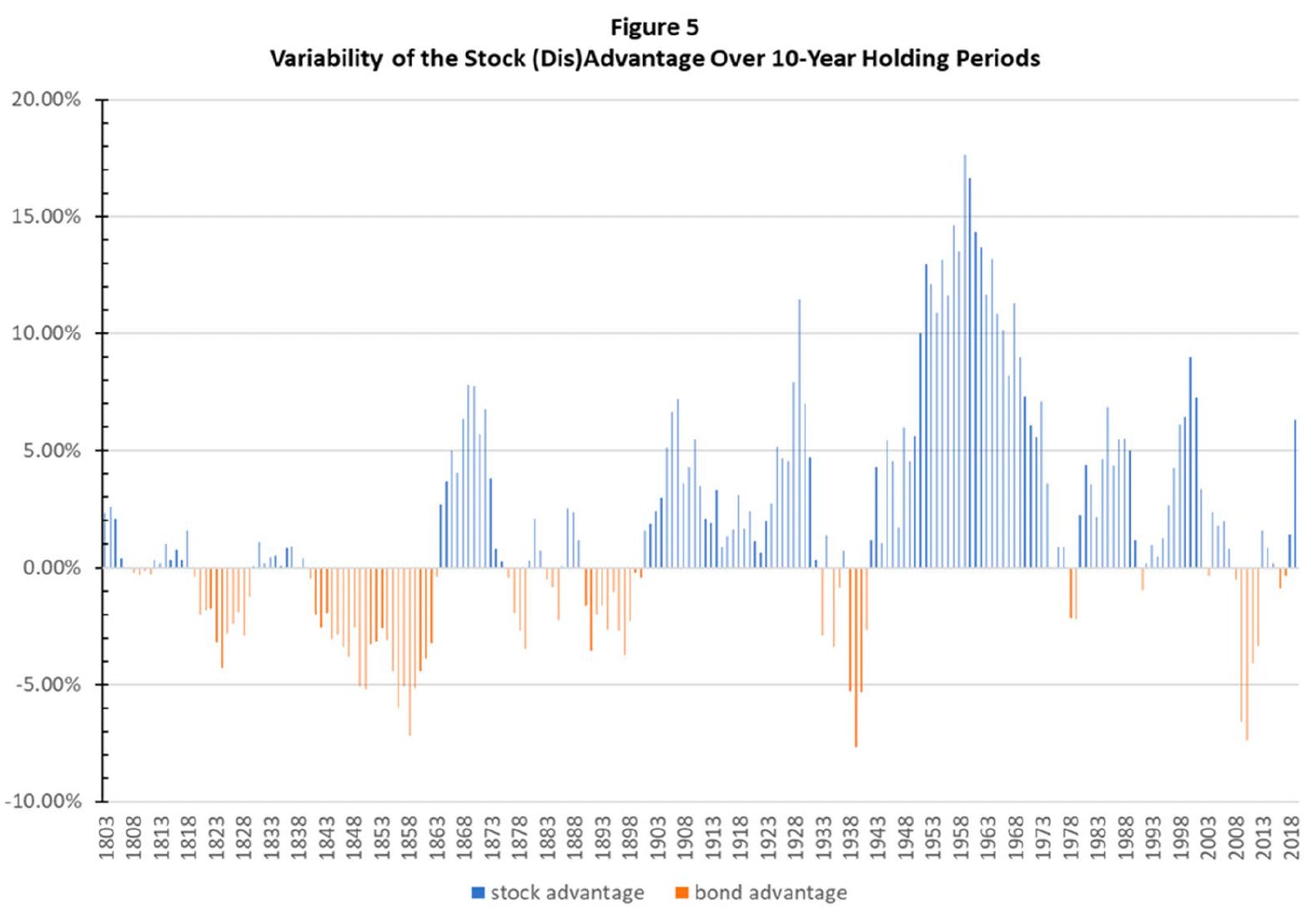
And after hundreds of years of data you would expect investors to ‘take a long-term view’ and bid up stocks to extreme levels ‘because stocks always outperform bonds’ which paradoxically would result in long periods of stock underperformance. You would expect that in an efficient market the outperformance of stocks over bonds would swing randomly back and forth over time due to these shifts in investor psychology.
Instead the outperformance of stocks over bonds is relatively consistent through time, and periods of under performance are short.
Trailing 10Y Annualized Stock Minus Bond Returns, 1802-2022
The Equity Premium Puzzle
To Economists this persistent outperformance of equities doesn’t make sense. It’s a puzzle.
Why is there this free money?
Why do stocks keep outperforming?
Or, to flip the question on its head and ask it another way, why are real interest rates so persistently low?
To put it crudely ‘why are bond yields so crappy?’
For the last 20 years real yields have been below 2%.
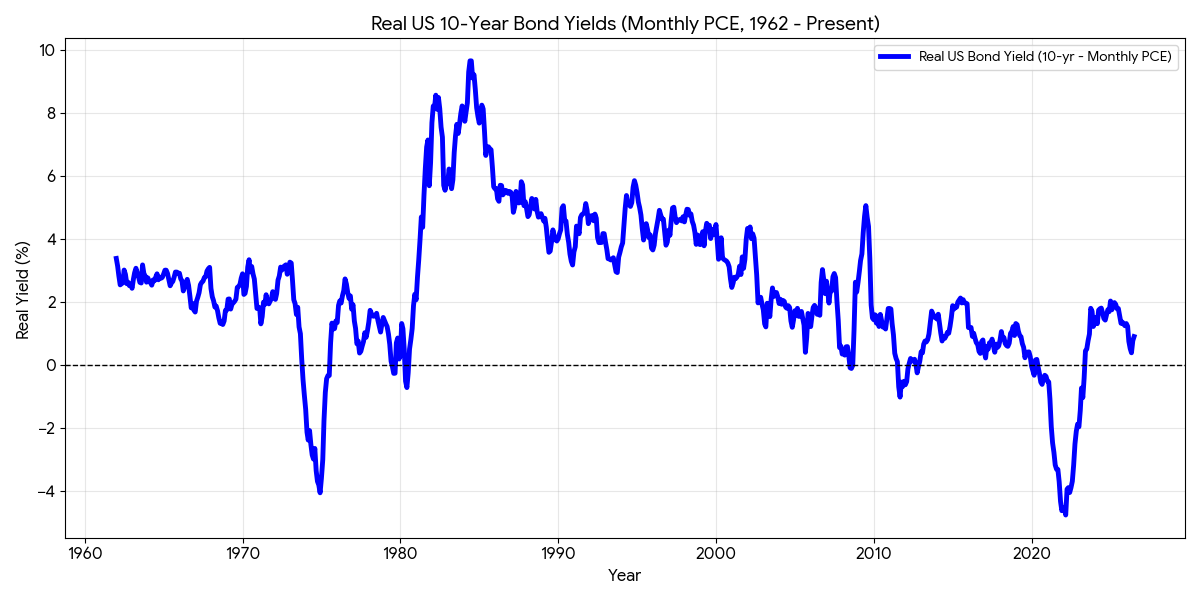
With S&P 500 EPS growth of 20% and inflation at 3% why are 10 year yields less than 5%?
Who would buy 10 year yields at less than 7% when stocks are doing so well? And yet they do. In the $ billions everyday.
Jeremy Siegel in his paper ‘The Equity Risk Premium Puzzle’ summarises all the different explanations economists have tried to come up with to explain the persistent outperformance of stocks.
One method to make the numbers work and explain why there is essentially free money on the table (a less risky asset which returns more’) requires assuming that consumers get much higher utility out of consuming goods than by foregoing consumption to invest in equities. But the numbers required to justify this are extreme and not realistic.
Economists also tried to ascribe the equity risk premium to extreme risk aversion. But the amount of risk aversion required to make the numbers work also doesn’t make any sense. Siegel goes through all of these attempts in his paper.
Another thought is that this is survivorship bias. US investors are perpetually scared of a big market ending wipeout which never comes to the US, but which has happened in other countries like Japanese and German stock markets in WW2.
US stock markets have just been lucky.
But lightening could still strike at any time.
Except, when you look at Japanese and German markets and the rest of the world the equity risk premium exists everywhere.
Yes, wipeouts happen, but stocks still outperform.
The equity risk premium effect is persistent across time and markets.
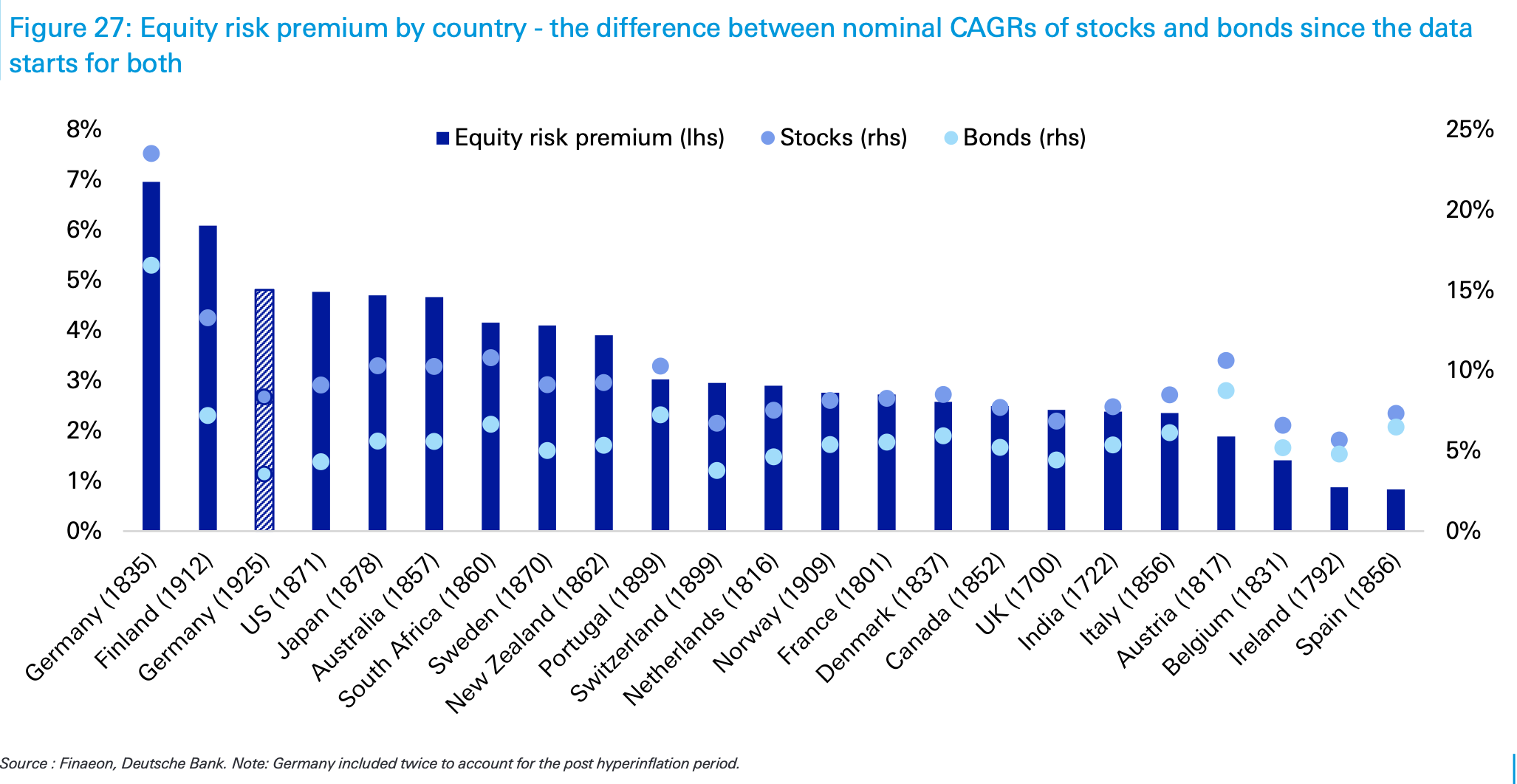
“History shows that investors have been consistently rewarded for taking risk and compounding the dividends and coupons available in equities and bonds.”
-Deutsche Long-Term Return Study
Another thought was that maybe the data doesn’t go back long enough. And maybe the bond data Siegel used under represented bond returns in the early 1800’s.
Edward McQuarrie in his paper ‘Where Siegel went Awry:Outdated Sources and Incomplete Data’ adds a few more years to the data series and recalculates bond returns in the early years to conclude that for the first 130 years (1793-1923) bond and stock returns were the same. The strong outperformance of equities over bonds has only been over the last 100 years.
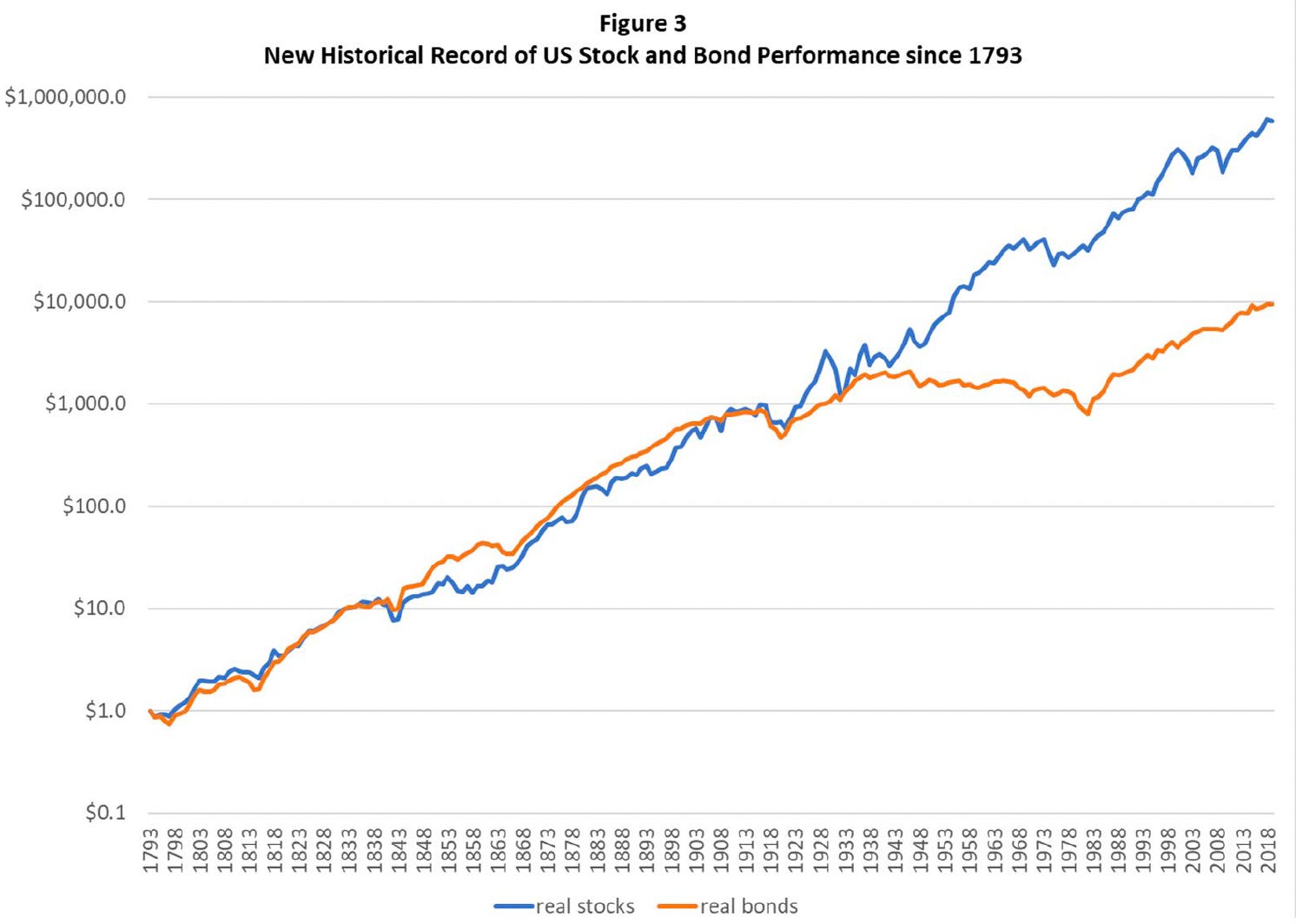
OK. Whatever.
There were 130 years where bonds performed the same as stocks then another 100 years where stocks did better.
Still seems like a good case for stocks.
So why is this equity risk premium happening and how can we trust it will continue?
I see two explanations which make sense.
We also conclude with a rule of thumb to know when the bull market is over.
