

Spacex is the most important company in the world.
‘is’, not ‘probably is’.
Many investors dismiss it as an overpriced hype stock.
Good for them. Don't make the same mistake.
Whether you own it or not, you need to be aware of what they are doing and how it impacts everything else.
Here are my takeaways from the Q3 results call.
It’s a mix of cultural and investment impressions.
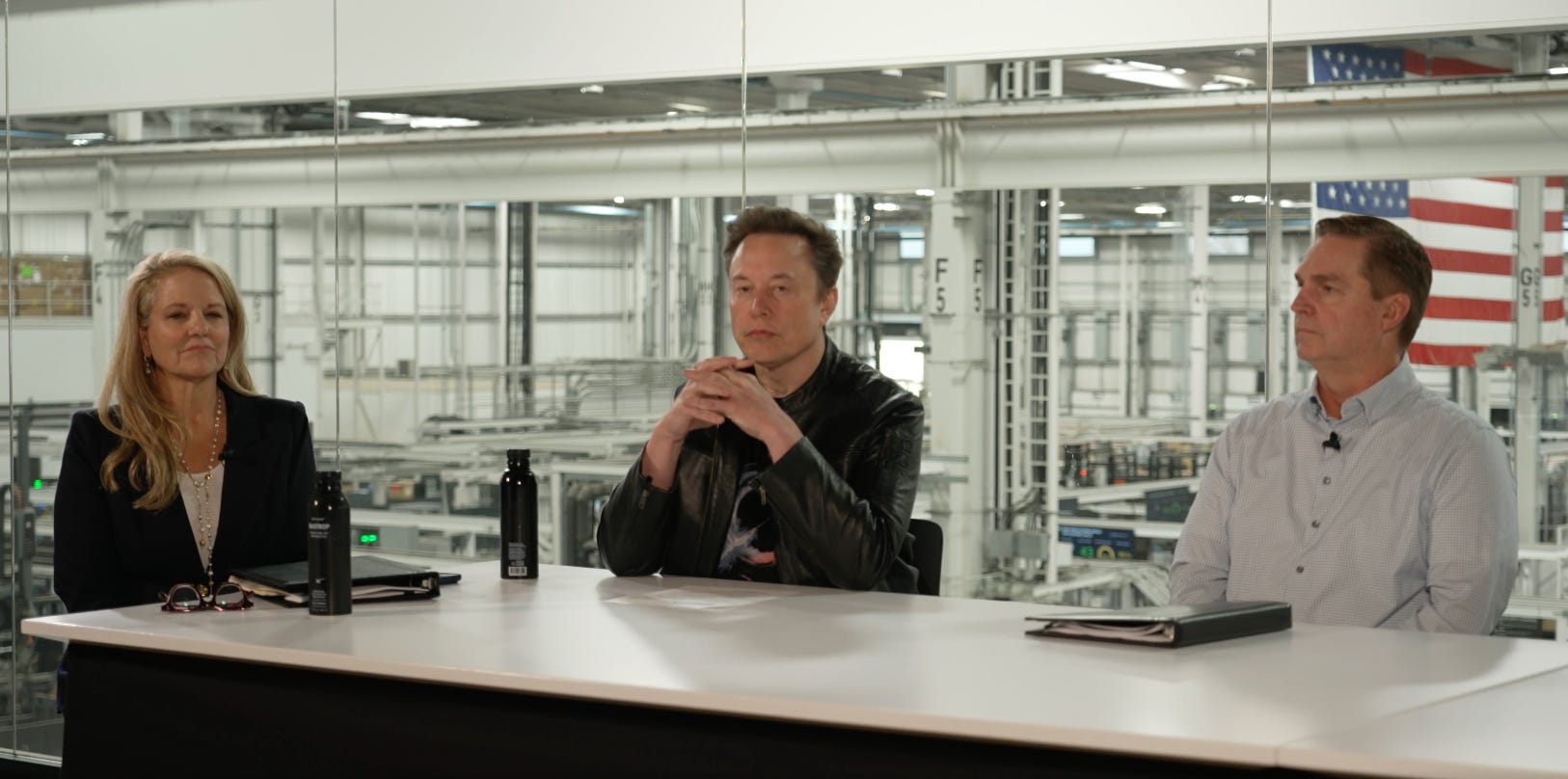
#1 Elon is changing America, geographically, culturally, geopolitically.
Look at the backdrop for the SpaceX Q3 investor call. $2 trillion company webcasting from a factory in Bastrop, Texas with an American flag in the background.
What is it saying?
Austin is the new Seattle. Bill Gates and Paul Allen left New Mexico because they hated it and returned to Seattle where they grew up, changing the city forever. Gates moving home turned Seattle into a center for global tech creating the network effects which led to Bezos packing up his car and starting Amazon there as well.
Elon is doing this for Austin. In fact I’d say he is doing this for the American South. Spacex manufactures in Texas, and launches rockets from Texas. He is building a Starbase in nearby Louisiana. ‘Starbase’ & ‘Louisiana’ Can you imagine those two words together? Have you ever associated Louisiana with high-tech?
Like I said. Elon’s changing everything.
I’m also extremely excited about expanding Starship operations to Louisiana with the second Louisiana purchase. The geography of Louisiana, the community, and their work ethic are so aligned for an amazing Starship future.
Yes, launchpads need to be near the water and Louisiana makes sense geographically, but is it just me, or if you read between the lines do you sense a slight jab at California? ‘The community and the work ethic are aligned’.
Then where is Spacex building their Colossus data center?
Memphis, TN.
He’s changing the center of gravity for tech in the US.
At the top I uploaded a 24 minute Spacex documentary ‘Test how you fly’. It’s tells the development of Starship. It’s inspiring and well filmed, but notice the imagery.


Elon and SpaceX are redefining cool.
Cool is not building websites for Microsoft in Seattle with lattes, hating your country and being a pain in the ass about everything.
Cool is working as a team building nextgen starships in Texas. Cool is advanced engineering. Cool is welding. Cool is patriotic.
And this girl…..
Rocket girl.
I love her. It says everything.
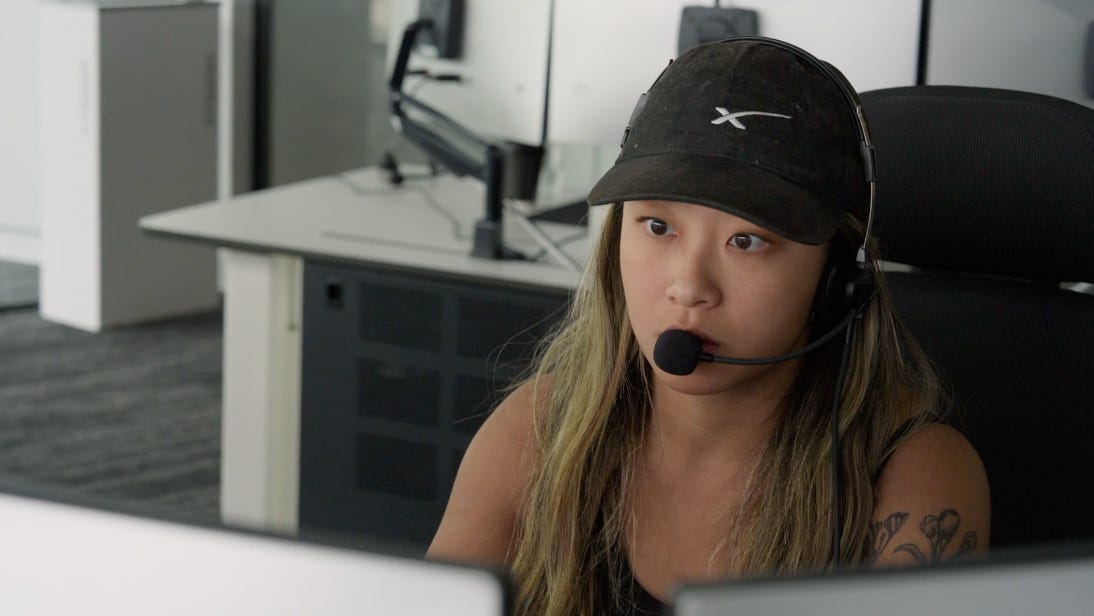
She’s sitting at the launch controls of a rocket test with her headset in a tank top, bleached hair, tattoos and SpaceX baseball hat. But you know she’s insane. She does matrix math in her head. You know she wouldn’t be sitting in that seat if she wasn’t in the top 0.1% of rocket telemetry experts.
She is the new cool.
Oh and by the way, all these welders are multi-millionaires.
That’s also cool.
That’s the geographic part (Texas, Louisana, Memphis) and the cultural part (rocket girl), but consider the geopolitics.
The US is pulling ahead of the rest of the world in so many ways. And the gap is accelerating. SpaceX embodies it and is also a big reason.
Global tech already runs on US platforms; your Microsoft Office, your iPhone, your Facebook, WhatsApp, your AWS, Azure and Google Cloud. All US.
Then with the Venezuela takeover, Russian sanctions and Iran War the US emerges as the world’s reliable source of energy.
Now SpaceX dominating satellite and rocket technology with 90% market share in launch capability.
Starlink dominating global communications.
And the capital markets capabilities. VC, Private Equity, Debt Capital and Public Equity markets all coming together to fund this bold project.
Leading the world in AI, Datacenters, Space, Defence, Energy, Communications, and Capital Markets…..
I know we stress about China all day… but I don’t think it’s really that close. Yes, there was a gap in manufacturing, but you can see that industrialisation in the US is happening and that gap is closing.
I always say there are opportunities everywhere, but what SpaceX is building reinforces that the US is truly amazing.
Maybe it’s right to be over allocated to the US.
Those were my cultural takeaways.
On the business side.
#2 SpaceX is Checkmate
I’ve owned Tesla before, and as part of owning it I modelled out all their initiatives. The cars, the CyberTruck, Tesla Semi, robo-taxis and Optimus (the humanoid robot). As an analyst what has been disappointing is that Tesla has been slower than my model in ramping all these projects. I get why sell-side analysts pick at Elon.
I get annoyed with Tesla. Why hasn’t Tesla Semi launched faster? Why still the same ugly version of the CyberTruck? Why does the S-Class look the same? Why so slow on new model changes?
But with the SpaceX call I see a different picture. Potentially.
I think Elon is strategising way ahead. I think he builds capabilities piece by piece and has a plan in his mind of how this all comes together.
Look at SpaceX. We thought it was a rocket ship company and Elon was fascinated with going to Mars. Seems farfetched. But whatever.
Then we realise what that rocket technology unlocked. All of a sudden SpaceX can launch satellites cheaper than anyone else. SpaceX then takes this capability and moves into the global communication business with Starlink. Cheap launch capability was the key checkmate move. We were never sure where things were going with Starlink, but now we see once Starlink had superior launch economics it could backfill in everything else later to outcompete AT&T and Verizon. Which is why those stocks are crashing. Investors already see what is going to happen.
SpaceX is also building its own frontier model, Grok. Think about that. Every other business in the world will be renting their intelligence from Anthropic, OpenAi or Gemini. SpaceX is building their own intelligence in-house. And Grokbot use is exploding.
On the Grok Bot side, we’re seeing the fastest growth of a product that I’ve ever seen in my life for Grok Bot. I’ve never seen anything grow this fast. We’re also seeing that the usage of Grok Bot grows over time per user. It does not decline. As we make Grok bot more useful, we’re seeing users use it more per week, not less.
Companies increasingly using Grok Bot as a force multiplier across sales, marketing, IT, and engineering, treating it as an always -on teammate for complex end-to- end workflows.
SpaceX is also building their own datacenter compute. And thanks to the advanced engineering skills at SpaceX they are solving the power and cooling challenges faster than anybody else.
As I think people are starting to realize, the constraint on deployment of super intelligence is more in power and cooling and infrastructure than it is in chips. What we’ve done at SpaceX is we’ve taken a team that has been able to achieve a market share in mass to orbit that is almost 90% of all mass to orbit of Earth, where China is about, I think, roughly 6%, and the rest of the world combined, including the rest of the U.S., is about 4%.
A team that has been able to achieve results that are an order of magnitude greater than the rest of all competitors in space combined, and applied that same team to the deployment of terrestrial compute.
This is a bit like the New York Yankees playing in Little League. It’s not fair. But the net result is being able to deploy power, cooling, and infrastructure at a rate that is vastly faster than anyone else, and may at some point be faster than everyone else combined. So, just let that sink in for a minute.
With Terrafab SpaceX will also manufacture their own chips.
We do have, I think, some significant potential breakthroughs in chip fabrication, but I don’t think I should discuss that on an earnings call. Let’s not give away the shop here. But I am optimistic that we will dramaticall y accelerate chip production and that Terafab will ultimately do what the name suggests, which is to make a terawatt of super intelligence chips per year.
Oh. And one more thing on Starlink.
We expect the market for communications to grow far beyond just human communication that we traditionally think about. Connecting cars, robots, and the adoption of Super Intelligence will increase communication demands, not in percentages, but in many orders of magnitude. In the years ahead, we expect Starlink alone to represent a significant portion of global Internet traffic.
Starlink will be the AI Agent communications network.
Now bring it all together. And consider Tesla.
SpaceX runs the AI communications network.
SpaceX has it’s own super intelligence, with in-house compute and chip manufacturing.
Now merge it with Tesla.
Tesla has in house battery, automotive and robotics manufacturing.
What do you have?
You have an unbeatable autonomous platform.
Robots and cars you manufactured, powered by your own batteries, running on your own AI models, software and chips, all communicating to your own datacenters on your own in house AI communications network.
It’s a complete vertical stack.
How does anyone compete with that? It’s a monopoly in the making.
And it’s why I think Tesla has been slow walking things slightly. Elon sees how this all comes together. Why waste lots of time and effort on V2 of the Tesla cars and trucks when V3 is around the corner with fully autonomous AGI robots and cars running on Tesla chips and communicating through Starlink? To Elon changing the style and colours of the cars or Cybertruck are childs play to backfill in later. The checkmate capabilities to lock in now are the satellites, chips, datacenters and Grok intelligence.
And why spell all this out when you are trying to merge the two companies?
#3 Are we worrying unnecessarily about compute?
Elon’s comments about compute were probably the most useful part of the conference call in terms of what the market is worried about right now.
Debt capital markets are panicking that datacenter builders like Oracle and Coreweave are spending too much too fast on compute for customers who won’t be able to charge enough for their AI services, which will lead to debt defaults.
Elon’s message is the opposite. Datacenter capacity is a scarce asset getting more valuable by the day. It can be rented out many times over. Compute rental rates are rising, not falling and the payback is less than 1 year.
Stop freaking out about whether these datacenters will get monetised.
In his own words:
Our belief is that the value of compute per watt will increase over time, not decrease. And the reason for that, I think, should be obvious to people, really, is that as you improve the AI software, as the models get better and better, you get more useful intelligence per watt. And the value of that compute is proportionate to the useful intelligence per watt.
And that’s why you see things like even old computers, like H100s, renting for more than they rented when they were new. And I think that’s likely to continue. I think we’re going to face a shortage of super intelligence compute. And that shortage is going to remain for a long time. I think the smart move is to do short-term contracts and essentially to place the bet on useful intelligence per watt increasing rapidly, which it obviously has done.
And also, if you look at, say, how are our short-term contracts renewing? Are they renewing at higher dollars per watt or lower? And we see them renewing at higher dollars per watt, not lower dollars per watt. We are also, frankly, hounded relentlessly by every hyperscaler and by dozens of smaller companies to rent more of our compute.
We could rent out our compute several times over if we said yes to everyone. That’s just the situation here.
That’s why I posted that sort of video of me, of the Monty Python cheese shop sketch, where the guy goes into a cheese shop to get some cheese and they actually have no cheese. And so he goes like, what about this kind of cheese? What about that kind of cheese? And they really just don’t have any cheese.
So we’ve actually tried to offload some of our inference compute to other cloud providers so that we can use more compute for training. And we get the cheese shop sketch.
We’ll ask them about, what about some GB300s?
Don’t have any of those.
What about some GB200s?
Don’t have any of those.
What about some TPUs?
No.
What about some Trains?
No.
What about some — okay, how about some H100s?
And like, well, we might have some overseas somewhere, and then they’ll check and come back and say, no, we don’t have that either.
It’s ridiculous.
I don’t think we’re going to have a demand issue here.
And it’s not impossible. I’m not saying this will happen. It’s not impossible that we will have a six-month payback period for compute next year.
Summary:
Elon’s cheese shop sketch on how hard it is to get compute should calm us about AI spend. Guys in the business with capacity are guarding it closely and careful about offering compute to 3rd party customers. And if they do it’s only on short-term contracts.
It also makes me wonder if Tesla is an attractive way into a monopoly in the making.


