

All day you are flooded with stock ideas and themes.
Everyone telling you the next great investment idea.
Ideas and themes all over the place.
But how do we put them together?
How do you build a portfolio?
Few ever talk about how to build a portfolio.
Yet, it is arguably the most important part of the process.
What are sensible guidelines and tools for portfolio construction?
Did you weight that super amazing idea at 1% or 20%?
1%? Oh sorry. And meanwhile the bad idea was 3%?
Here are my thoughts on portfolio construction having seen the academic side of it as well as the real life side.
And of course there is a new YWR tool for you:
But first some background.
‘Best Ideas’ or ‘A Delicious Soup’
There are two schools of thought on how to construct a portfolio.
One is to consider each idea independently and build a portfolio of the Best 10-15 Ideas. If each of the ideas are good the portfolio should eventually perform well in the end on a total return basis. This is similar to how a VC looks at his portfolio; a collection of individual bets which hopefully performs well over 10 years. Any one of which could be a home run and generate the returns of the whole fund. The view is don’t get overly focused on correlations and risk management. Pick the best businesses or investments. Fundamental long-only managers like this style.
The alternative is to build a portfolio as you would construct a delicious soup. The ‘delicious soup’ you are building is a return stream with varying degrees of risk and return depending on the ingredients. You want this balance of return versus risk to be as high as possible (the Sharpe ratio). To cook your soup you fiddle around adding a little small cap here, a dash of real estate there, a sprinkle of CTA….
Unlike the Best Ideas portfolio the delicious soup might include positions which wouldn’t make a list of twenty best ideas, but which are uncorrelated to the rest of the portfolio. These positions zig when everything else zags. On a 10 year total return basis they might not be the best, but day to day the ride is smoother. Investors in the soup portfolio value lower volatility. The delicious soup method is important for managers running public funds with daily or monthly liquidity and don’t have the luxury of multi-year lock-ups.
Modern Portfolio Theory
The academic expression of the delicious soup is Modern Portfolio Theory by Harry Markowitz. In Modern Portfolio Theory (MPT) investors analyse the return and volatility of every security in the market and combine these securities to create optimal portfolios with the best mix of risk and return. Investors mix and match the securities to create the delicious soup that best fits their taste. There is an optimal frontier with every flavour from low volatility-low return to high vol-high return and everything in between.
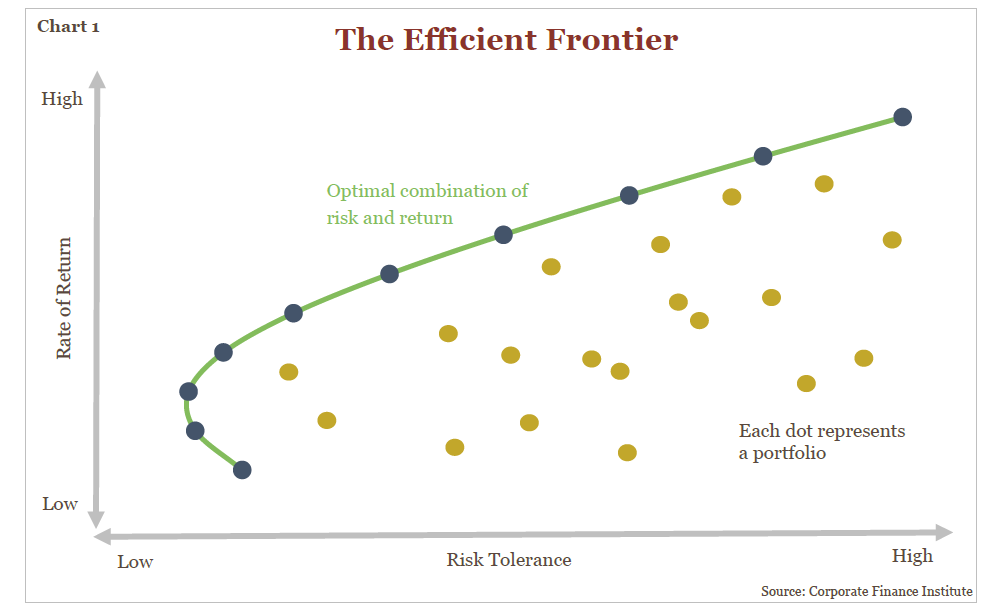
Like many things in economics MPT makes sense as a concept but is hard to implement in real life. The problem with MPT is there is no way to know the actual future return of a security. We can only guess. The other problem is risk metrics such as volatility and correlation are backward looking. We know how volatile a security used to be, not how volatile it will be in the years ahead. So the MPT breaks down in practice. Yes, it would make sense to build an optimal portfolios based on the future risk and return, but there is no way to know the future return or the risk.
Portfolio Optimisers
But the MPT concept is cool, so quants figured out how to make a version of it work using portfolio optimisers. A portfolio optimiser takes a universe of potential stock ideas and creates the ‘optimal’ portfolio based on your estimate of future return (or some related measure) and historical volatility or correlation as the risk measure. It’s a work around.
In practice a fundamental research team might create a list of 30 best ideas based on their models and meetings. The quants then ask the fundamental analysts to give each stock a price target or a conviction score. This is the ‘return’ input for the algorithm. The historical (last 5 or 10 years) volatility and correlation of the ideas to each other are the ‘risk’. This data is easy and comes from historical price data. But is backward looking.
The quants feed the return and risk of each stock into the optimiser algorithm… then beep, boop, beep, boop….a few seconds later the optimiser spits out the ‘optimal portfolio’. It tells you the best soup you can make with your 30 ingredients.
I like optimisers.
But I have my own take on Best Ideas, Delicious Soups and optimisers.
A hybrid a approach I call the YWR 3-60 Portfolio
The YWR 3-60 Portfolio
Disclaimer alert! This is a guideline.
This is not financial advice.
First, some grounding assumptions which you may or not agree with.
Fact #1. You only have 3 good ideas. The market is flooded with information and ideas. It’s impossible to have a view on all the sectors and themes. You are only human. Yet, many people try to build a diversified portfolio with 15-30 different ideas where they think they have a view on everything.
My take is this. We have simple minds and most of the time only have a differentiated intelligent views on 2-4 themes. Really we have are 2-4 good ideas, but because we think we need to be ‘diversified’ we dilute the good ideas with 10 mediocre ones.
The result is a mish-mash portfolio that struggles to beat the market. 2 of your 3 themes worked, but then 1 of your other 10 ideas wiped it out, and you ended the year +10% when the market was +12%. Sound familiar?
The ‘3-60’ in the YWR 3-60 portfolio is to take your top 3 themes, where you have conviction, and make them the bulk of your portfolio. Make those 3 core themes/ideas 60% of the portfolio. Or 50% if you want, but put more weight on a smaller number of themes.
More bat on the ball.
That is the key idea. And it’s deliberately simple.
Like your brain.
Fact #2. The market index returns are good and 85% of professional fund managers have been unable to beat the index over the last 10 years. If none of the fund managers can beat the index the odds of me or you beating the index are low as well. Maybe we should save money on Substack subscriptions and market data and just buy an index fund.
Or, maybe there is an approach where we can still beat the market.
Let’s allocate 60% to our high conviction ideas. But then for the rest of the 40% of the portfolio consider buying an index fund. Or, if you can’t help yourself and have to buy lots of different stocks make the remaining 40% a mix of 2-4% positions which will average out to an index like return. Try to not make these big bets. The big bets are in your 60% allocation.
Fact #3: Your brain is not great at running complex correlation analysis. That’s not what it does. And MPT is correct. 4 uncorrelated ideas are better than 4 ideas which are all the same bet. Use an optimiser for suggestions on how to weight your 3 top themes.
The challenge for us is that a lot of themes seem different on paper, but actually have high correlation. On paper they look like different sectors or geographies, but often there is an underlying macro sensitivity which makes them all trade same.
That correlation is what the optimiser sees, which many times you can’t. That’s why I suggest coming up with 3-4 high conviction themes and then asking the optimiser how best to weight them. It’s just a suggestion, but it’s interesting to see what the optimiser says. And it’s better than no process at all, which seems to be how we usually determine portfolio weights.
Putting it all together.
The YWR 3-60 portfolio construction process is simple a hybrid approach. It takes the fundamental high conviction best ideas style (but only 3 ideas because those are the good ones) then uses an optimiser to help figure out how to weight those themes and make a delicious soup.
And don’t worry if you don’t have a portfolio optimiser.
I built one for you.
The YWR 3-60 Portfolio Optimiser
Here’s how it works.
Pick 3-5 ‘themes’ using ETF’s. In your real portfolio you can use individual stocks, but for this risk analysis piece we are using ETF’s to approximate themes.
For each theme give a conviction score. This is your ‘expected return’. 5 is high conviction/high return/you love it, 1 is low.
Then click ‘Build my 3-60’.
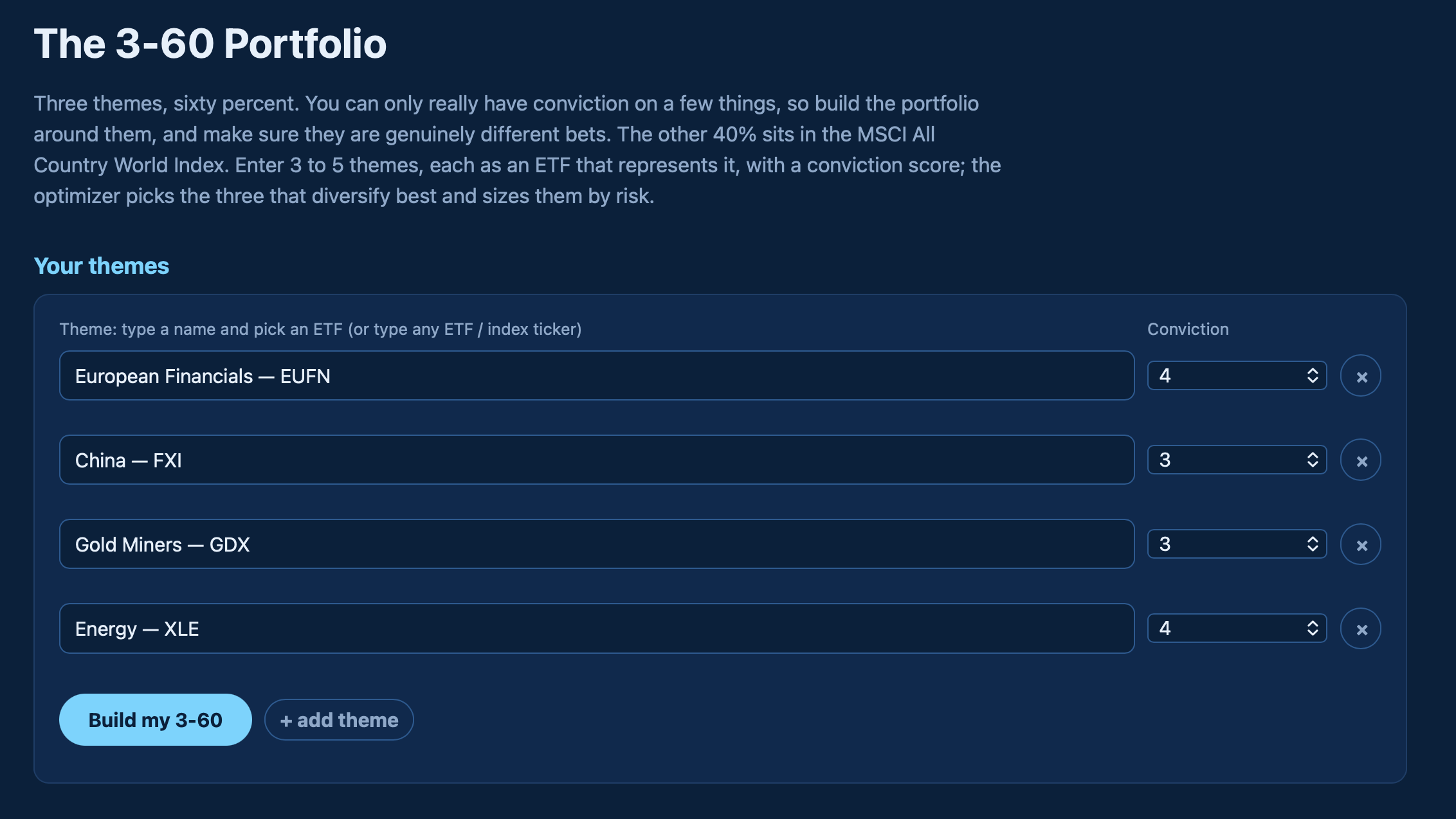
Given the themes you entered, combined with how much you like them (conviction score) the optimiser is going to calculate the optimal weightings for each of those themes considering the correlation of those themes to each other and to the other 40% weighting in the MSCI All World Index.
Remember that last part. If your ‘theme’ is tech and tech is also 30% of the MSCI All World index the optimiser is going to see the high correlation between the two and not be wild about it. ‘It’s all the same bet’.
There is also a constraint that the max weighting for any ETF is 25% of the portfolio.
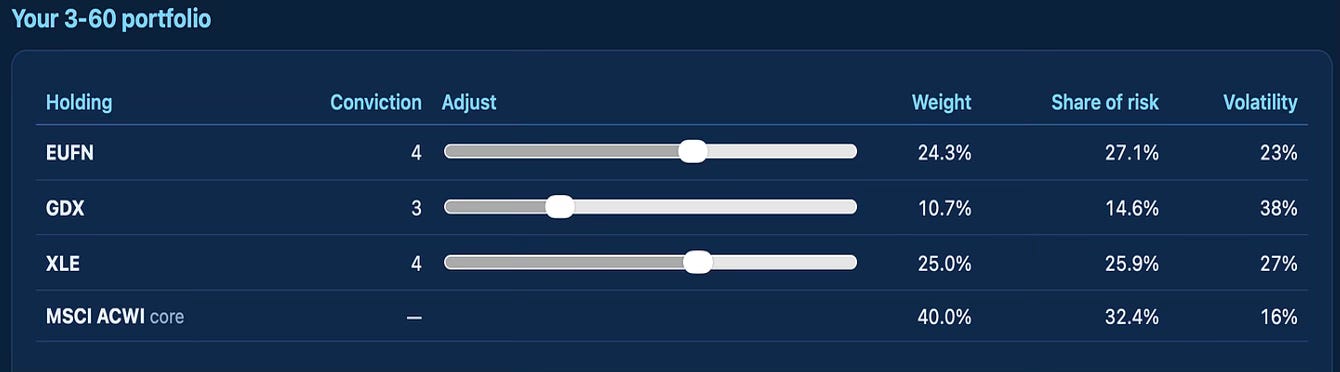
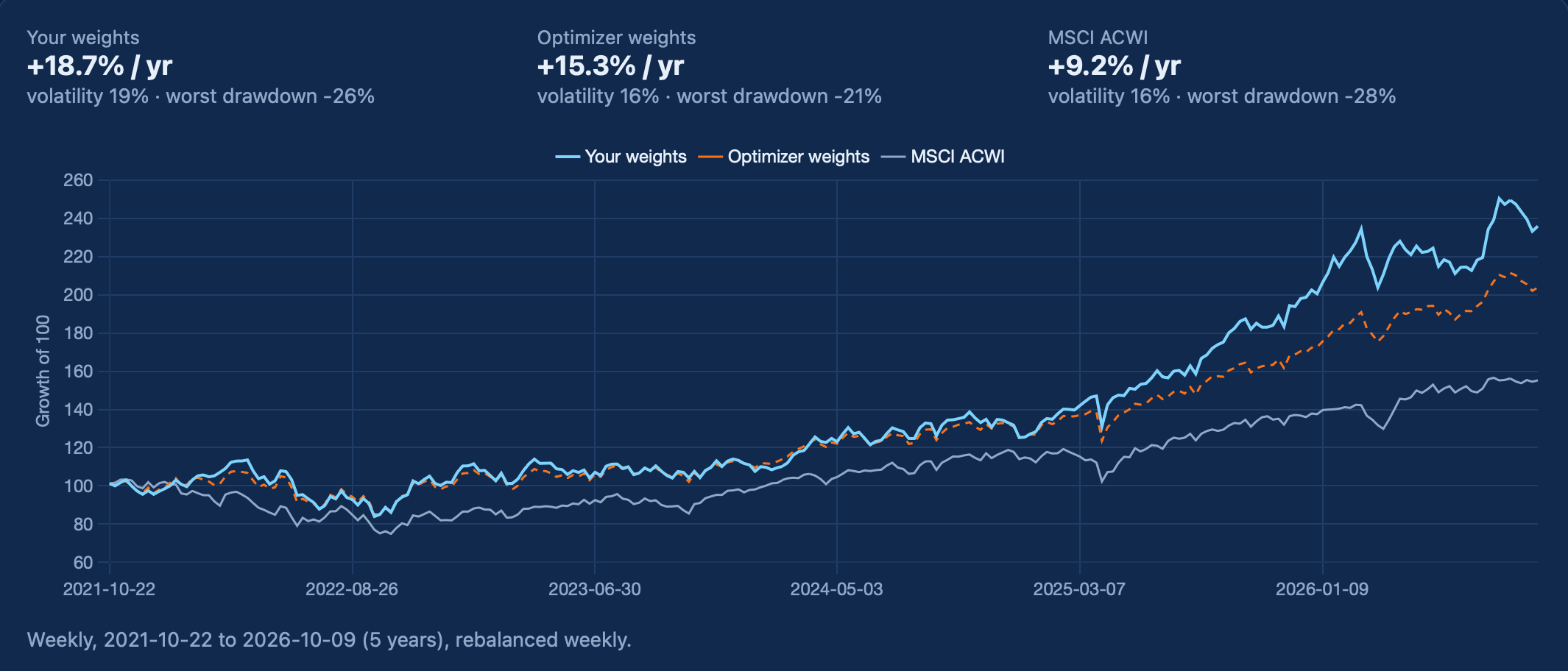
Below the optimal weightings output there is a chart with the historical performance of your optimised portfolio and the MSCI AW index.
You can adjust the sliders to increase the weighting of any of your themes. The adjusted portfolio will show as a red line in the chart (‘Your weights’). The charts and performance are backward looking. The overall volatility number is also backward looking but important to note.
I want to show you how this can be helpful.
Let’s say you like European Banks, China and the NASDAQ. Which I kind of do. And let’s say you like them all equally. Below is what you would enter into the optimiser. All of them get a ‘3’ for conviction. Theme 4 is empty.
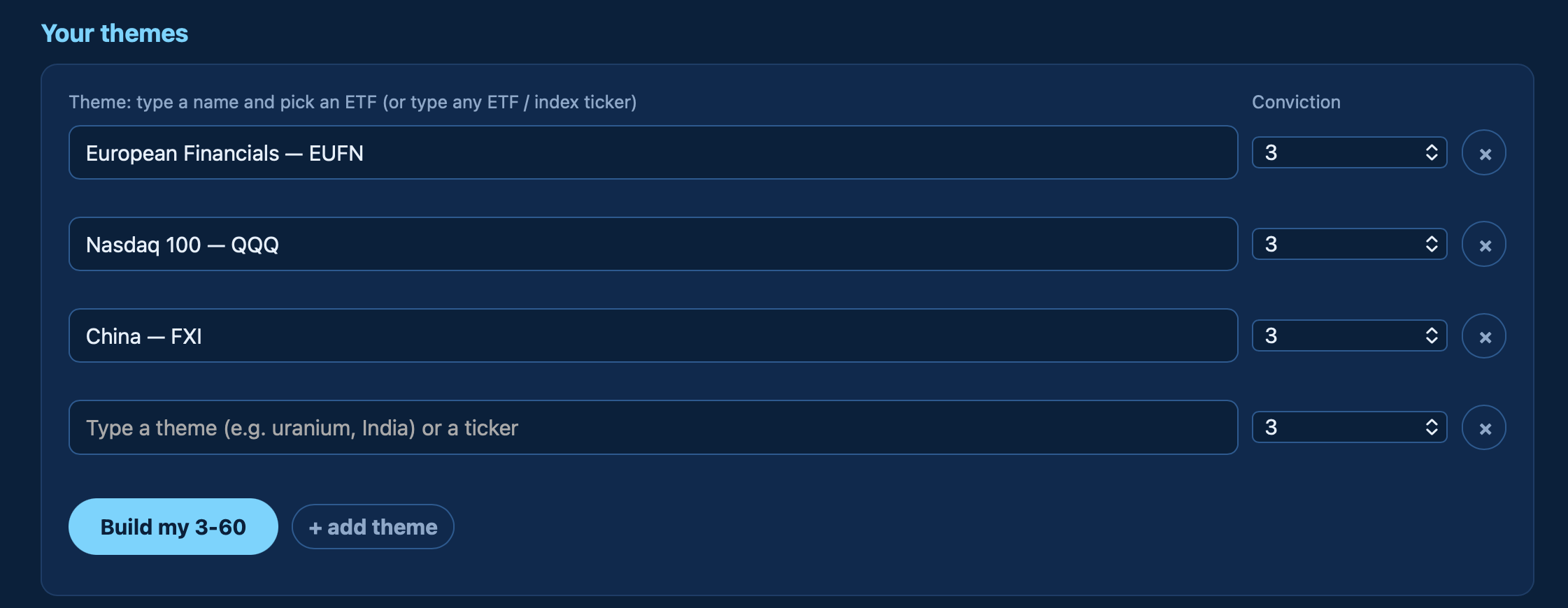
These seem like 3 different bets. Europe, China and US Tech.
But when you put them in the optimiser it picks up that European Banks have been trading a lot like NASDAQ which also trades like the MSCI AW index, which is the other 40% of your portfolio. FXI is the only differentiator in the whole book. When the optimiser looks for the best risk/return it likes China’s lower correlation and increases the weighting. In fact it takes China to the highest weighting possible. 25%.
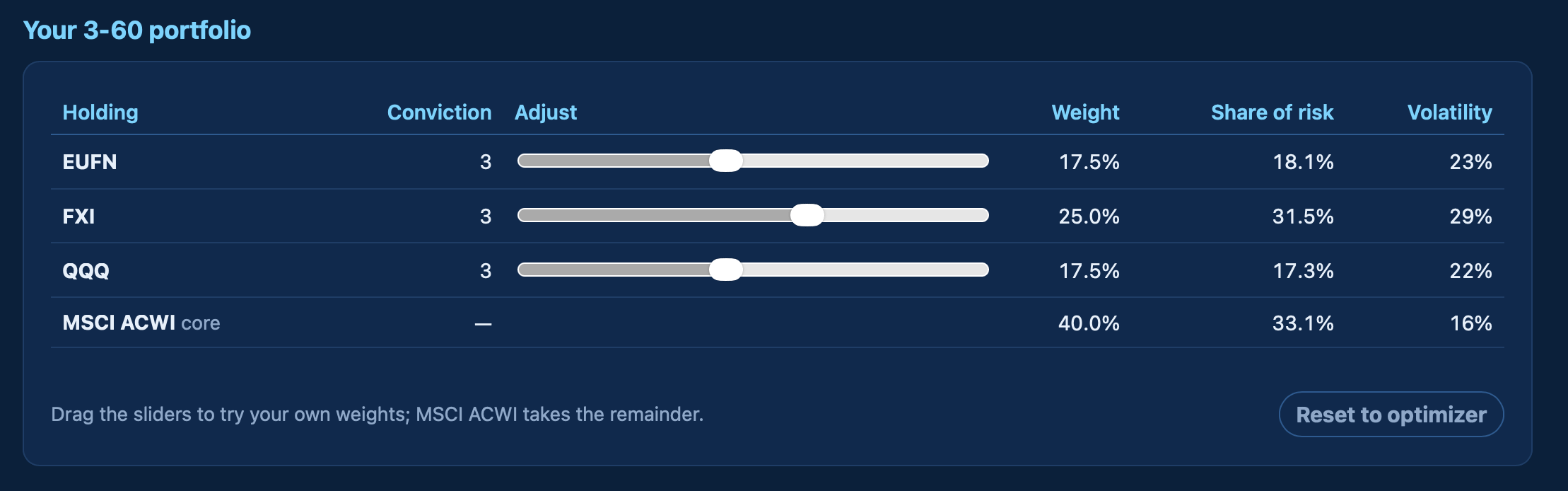
That’s why I think it’s useful. I don’t think you would look across your portfolio and make the connection that Europe, Tech and MSCI AW are all the same trade and that if you say you like them all equally, of the three it makes sense to add more China.
Here is the link again to play around with it now that you know how it works.
Remember that the optimiser is a simple mathematical algorithm maximising two variables (the conviction score you gave for each theme and portfolio volatilty). All the optimiser knows for volatility is the last 5 years of returns, and all it knows for the future returns are the conviction scores you give it.
That said, it’s a useful tool to help analyse portfolios and construct themes in a way that they aren’t all the same bet.
Have a good weekend.
Erik
Getting some fun results: (1) 3-60 prefers Topix Banks (1615.T) to EUFN even with -2 conviction drag (e.g. 1615 gets 3 for conviction, EUFN gets 5), (2) it'll massively overweight anything not on a nice uptrend over the past 5 years such as EWZ, FXI, TLT(!).