

I had a surf lesson this morning.
At one point we were sitting out on our boards side by side, out beyond the break, bobbing together enjoying the view, and the instructor wanted to share with me an important lesson.
He pointed to some other surfers to our left catching a different break.
He said when you are out trying to catch waves, don’t focus on what everyone else is doing. If you are watching everyone else, you aren’t paying attention to the ocean and won't be in the right mind frame to find the next wave.
‘Find your own wave’ he told me.
He was very spiritual about the whole thing. He also instructed me that paddling back out after catching a wave was an important time. It wasn’t about just paddling. You should be settling your mind and ‘tuning in’ to the ocean. That ‘tuning in’ while paddling would help you catch the next wave.
Which brings us to multi-manager pod shops and factor hedging.
There is an estimated $500 bn of capital invested in multi-manager hedge funds (pod shops). When you consider they might be 4x leverage it is likely $2 trillion in exposure. Maybe more. And they are all selling a similar strategy. They are selling ‘alpha’.
I’ll keep this to equities, where it is more clear what this means. The hedge fund is ‘hedging’ out everything which isn’t stock specific risk. That means being short stocks as much as being long, which takes out the ‘beta’ of being long the market. It also means hedging out any factor exposures like value versus growth, or small cap vs big cap. I’m sure there are more.
The idea is that after all this beta and factor hedging is done there should be a residual return stream which is pure ‘alpha’.
Except something tells me when $2 trillion of capital tells you they have taken away all the risk of the market crashing and they are purely exposed to ‘alpha’ it means the risk has moved somewhere else; something less defined. All those rules and hedges must be somehow forcing the managers to take similar bets.
But it’s hard to see. Until it all periodically unwinds.
Which it just did.
The Oct 1 - Nov 6 Alpha Crash
What happened over the last 5 weeks is fascinating. And an interesting lesson in how multi-manager pod shops are affecting market structure.
We have a crash of the biggest trend in the market, AI, and the market is flat. Let me repeat that.
AI crashed and the market did not.
It was an ‘alpha crash’.
Ask anyone two months ago their biggest fear and the would say an AI crash. Tech is 40% of the market so the logic was a crash of AI would take out the entire market. Except the opposite happened. Kind of.
The S&P 500 is down 4% while semiconductors are down 24%. AI (alpha) crashed but the market didn’t.
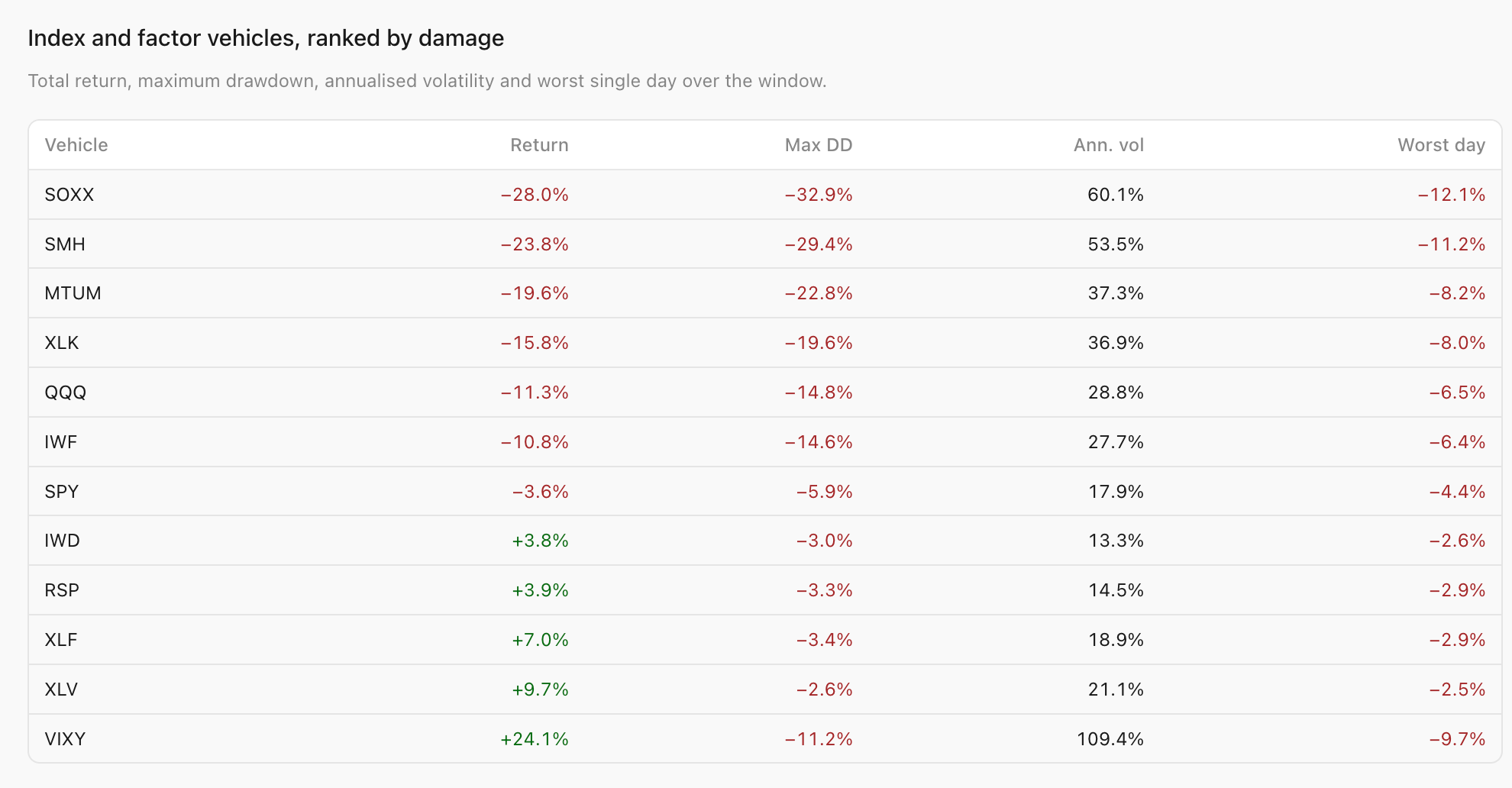
This ‘crash’ was very tightly defined to the AI theme.
Below are the top 25 most ‘crowded’ stocks going into October 1st.
‘Crowding is defined as the co-movement between stocks after stripping out the market return. These are stocks that are moving tightly together.
It’s interesting that this statistical measure of ‘crowding’ pulls up a very clear theme.
The top most ‘crowded’ names are the AI supply chain.
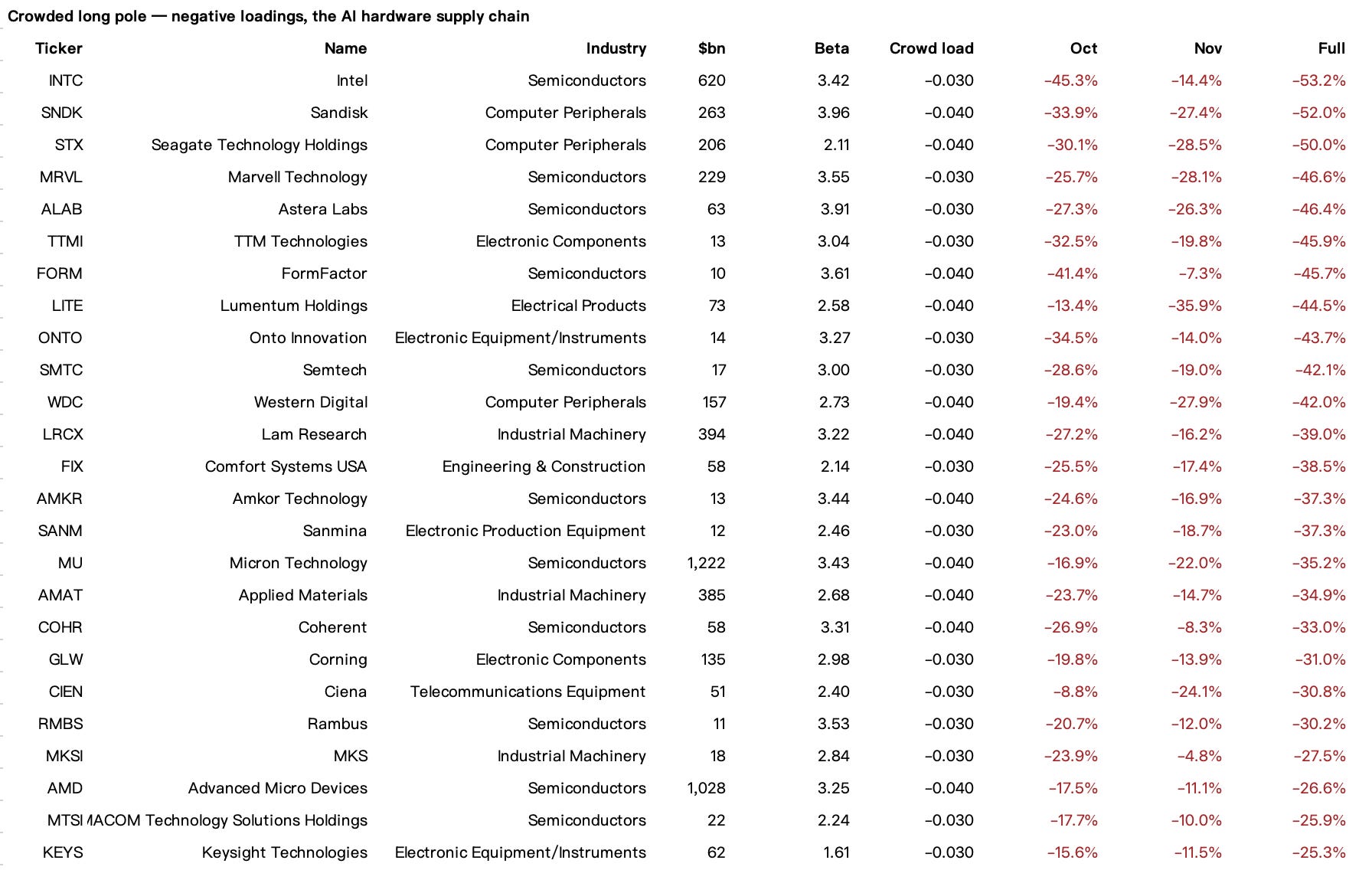
Notice the names differ by market capitalisation and sector. The sizes range from $11bn to $1.2 trillion and the sectors span Semiconductors to Industrial Machinery to Engineering & Construction to Telecommunications Equipment. It’s the data center build out. But a factor risk system can’t see that’s what it is.
Then look at the top most uncrowded positions.
It’s mostly stocks related to housing; homebuilders, REIT’s, home improvement). Which is all highly sensitive to rising interest rates.
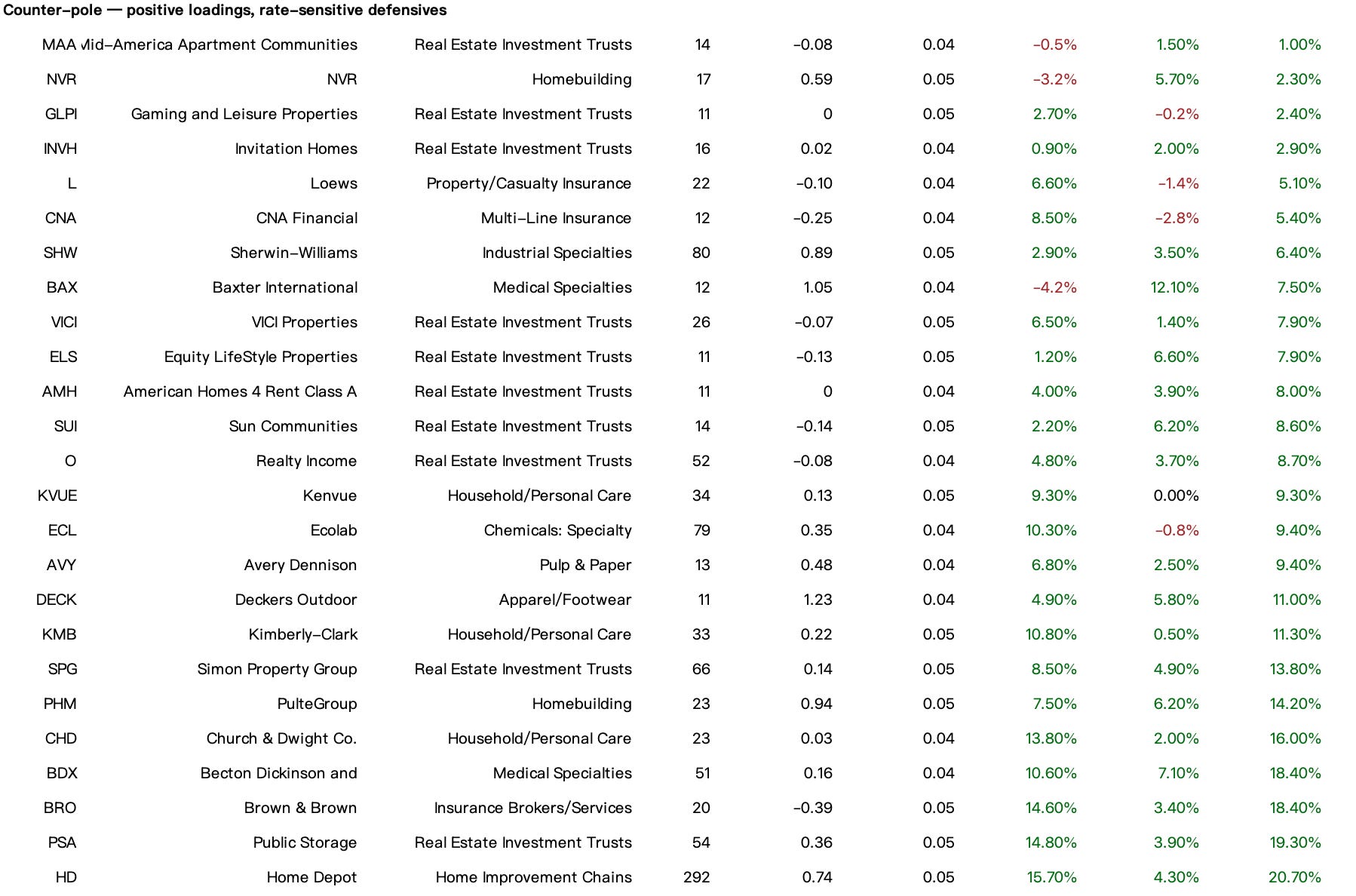
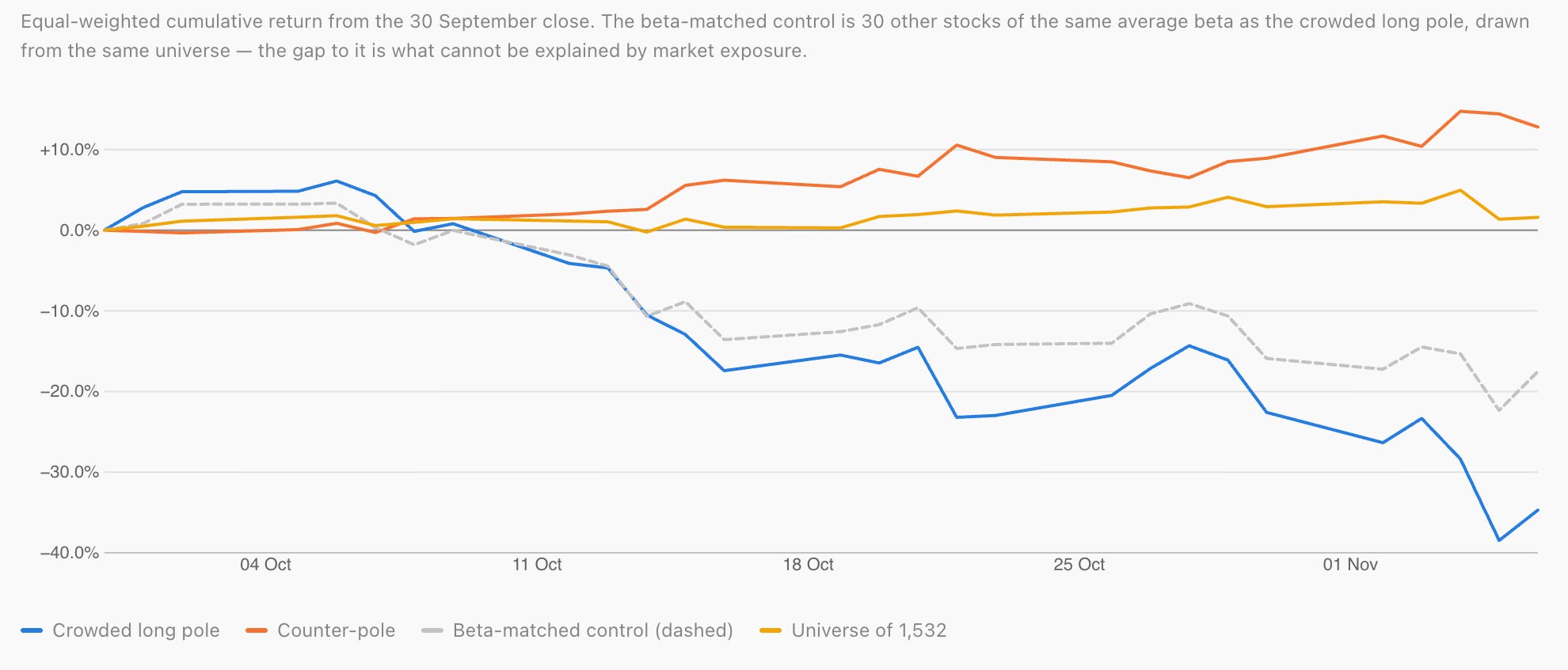
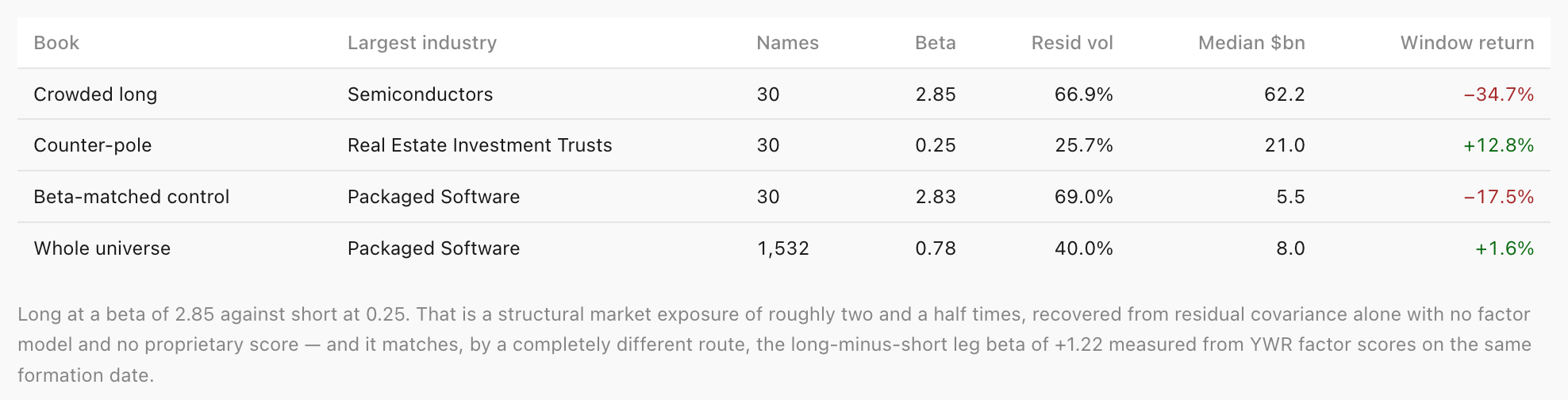
So we got a slow motion whip saw through October where the crowded longs were leaking lower while the rate sensitive shorts were slightly rising.
Then in the first week of November we must have hit a risk limit where it became too much, because the crowded longs suddenly dropped.
How to be an Anti-Pod Shop
So what is the opportunity in this ‘alpha crash’?
What is the meta takeaway?
As our surf instructor said.
It is to find our own wave.
The more I hear about complex leveraged strategies to gain exposure to ‘alpha’ and while avoiding any ‘beta’, the more it makes me wonder if ‘beta’, just being long the market, might be underpriced. Counterintuitively, the real risk might be in the ‘alpha’ strategies. Just look at the last 5 weeks. ‘Beta’ outperformed ‘Alpha’.
Fat Tony would say these multi-manager funds are making things overly complex to generate fees.
Fat Tony would say the opportunity is in doing the opposite of the multi-manager funds.
What does that mean?
#1 Be volatile. The obsession across the industry with ‘tight risk management’ creates these systemic washout opportunities. Unfortunately, these washouts are not predictable. But when they happen we probably need to try and take the other side of them. They are periodic market gifts. Be willing to take more volatility when others won’t. This is the new super power.
#2 Take lots of directional risk. We’ve been taught to fear market crashes, and so we should buy super complicated factor hedged alpha strategies which promise not to go down if the market crashes 20%. Or, buy private equity funds with no mark to market.
Is this constant fear of taking directional exposure to public equities the structural opportunity?
So what do we do?
Disecting the unwind of the crowded AI trend doesn’t tell us what to do next. This sell-off could signal it’s the start of the end of the trade. Things will still get worse. Or, it could be a perfect time to get long.
Here I’ll share two anecdotes, which make me think the AI trade still goes higher.
I don’t know anyone who is saying to aggressively buy AI names here. Everyone is writing how this is the start of a bigger AI unwind. A few AI bulls I know have gone to cash. That’s a good sign.
I had a call with a Math Phd quant trader today who had tried Claude Code for the first time and was amazed at what it could do. It reminded me how many people are not really using this technology yet. The penetration of Claude Code and Meta Muse are still low compared to where we are going.
The capability of the models is rapidly improving and it’s hard to think we are going to somehow stop investing in this. It’s like an alien life form which won’t stop growing in intelligence. Like the alien in the movie Life.
I kind of want to be long the alien.
Have a good rest of the week.
Erik