

Another guest post from ‘Tell it like it is’ David Quinn at Targeted Equity Consulting.
Investor sentiment remains remarkably negative. The list of concerns is long: recession fears, higher interest rates, oil prices, a K-shaped economy, dollar strength, the Iran conflict, the Russia-Ukraine war, and persistent warnings that AI and equities are in a bubble. Taken together, there is certainly enough uncertainty to keep investors awake at night. Yet markets and economic fundamentals continue to show considerably more resilience than the prevailing narrative would suggest.
Positioning is crowded, not just cautious
This is not merely pessimism as an attitude — it is pessimism as a position. CFTC data compiled by Goldman Sachs show leveraged-fund short exposure in Nasdaq-100 futures surging toward roughly $80 billion, while longs have held near $20–25 billion. The resulting net short of about –$60 billion was the most negative reading in several years. That crowding is a contrarian setup: if the tape keeps rising, short covering becomes fuel.
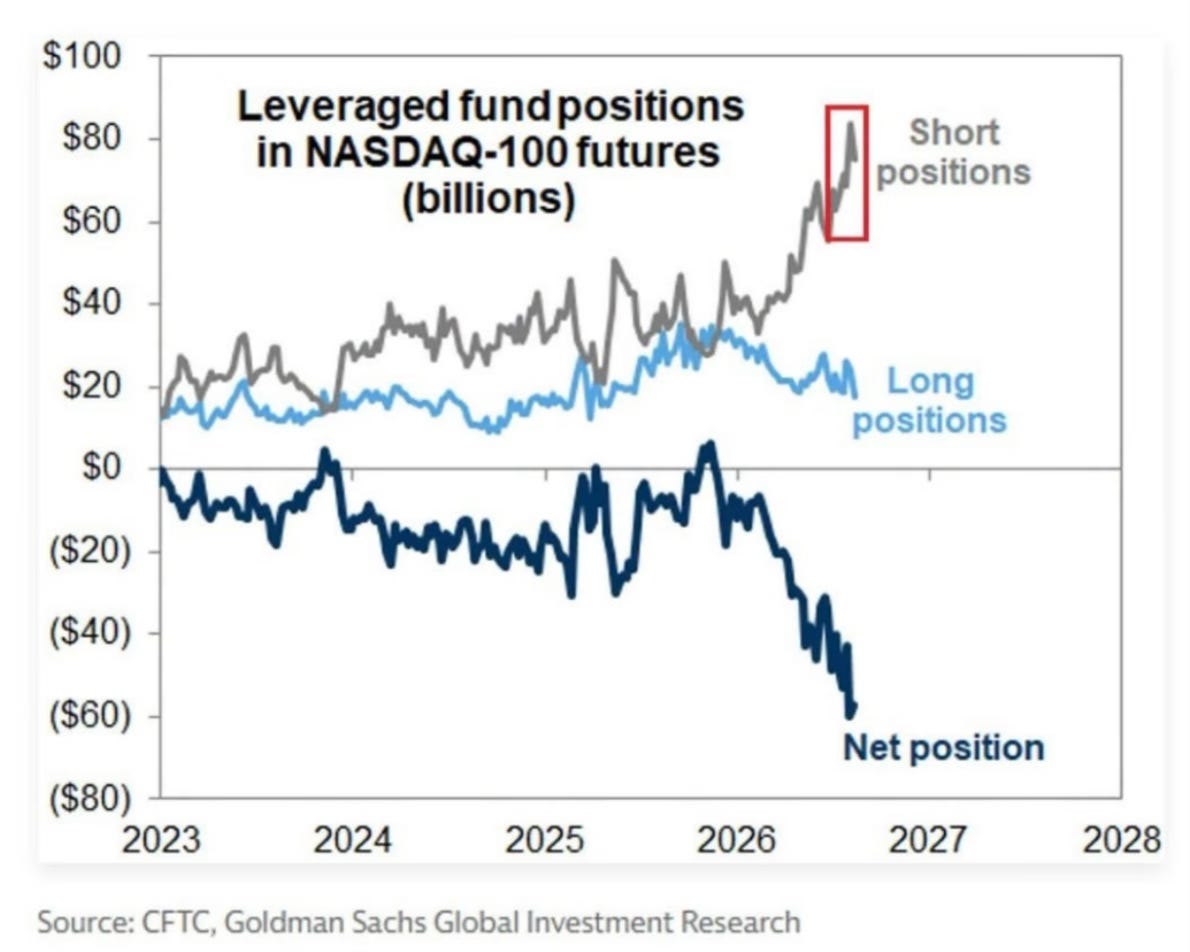
One timing caveat belongs in the note. The most extreme net short was concentrated in August; by late September it had moderated — CFTC data show leveraged funds net short roughly 31,000 contracts on September 22 versus about 62,000 on August 18 — even as gross shorts remained elevated. Pessimism is still elevated. The single most stretched reading has already started to unwind.
The consumer story is uneven, not broken
For years the rule of thumb was that housing drives the cycle. That linkage looks weaker now. There are legitimate reasons to be cautious on the lower-income consumer, where higher rates and affordability constraints bite hardest. But the recession thesis requires the whole consumer to be impaired, and the aggregate balance sheet does not support that. Household deposits and currency stand at about $5.43 trillion — only 0.9% below the recent peak, far above the pre-pandemic level. The cash stock built in 2020–22 has not been drawn down in any meaningful way. Money-market assets have surged from roughly $3 trillion before the pandemic to more than $8.4 trillion. Total household assets are about $206 trillion, up 6.6% and at a record, with household net worth approaching $186 trillion (+7.2%).


That changes the transmission mechanism of higher interest rates, which are almost universally discussed as a pure negative. They clearly hurt borrowers. But households holding trillions in cash,money-market funds, and fixed-income assets are earning substantially more interest income — at a 4% yield, $8.4 trillion in money markets alone represents roughly $336 billion of annualized income. The result is the K-shaped economy in action: higher rates squeeze the indebted end while transferring income to savers. Aggregate household balance sheets remain near record strength.
Geopolitical narratives have run ahead of outcomes
Oil is a useful example of how the narrative can outrun reality. Despite repeated claims that the Iran conflict and the Russia-Ukraine war would leave the world short of supply, oil has not delivered the sustained spike the bears expected. This echoes the earlier claim that the war would destroy the global breadbasket and produce lasting food shortages. In both cases the risks were legitimate, but markets adapted — through substitution, new supply, changing trade routes, and higher production elsewhere. A supply shock does not automatically produce the worst-case outcome, because prices themselves create incentives for the world to adapt.
The AI “bubble” deserves the most scrutiny
I have worked through the dot-com bubble, the China construction boom, and the U.S. housing bubble. Those episodes shared a defining characteristic: capacity was built dramatically ahead of actual demand. Fiber was laid that went unused. Homes were built for buyers who did not exist. China built enormous property and infrastructure in anticipation of future demand. When demand failed to arrive quickly enough, excess capacity sat idle — in some cases for decades.
That is not an accurate description of AI today. The distinction is the relationship between capacity and economically productive demand — not the absolute amount of money being spent.
Leading-edge compute capacity is not being constructed to sit idle. Demand is already here: hyperscalers are racing to secure GPUs, networking, memory, power, and data-center capacity, and newly deployed capacity is being absorbed as it is built. The useful life of the infrastructure may be shortening, not lengthening, because each generation of chips, models, and networking materially improves the economics of the last.
More importantly, AI investment has evolved beyond a conventional capital-spending cycle into a global strategic arms race. Leadership in AI could confer enormous advantages in productivity, scientific discovery, financial markets, cybersecurity, autonomous systems, and military capability. Nearly every Magnificent 7 CEO has framed falling behind as an existential threat. If management genuinely believes that, slowing spending simply because the numbers look historically large is not rational strategy. The question is the cost of over investing versus the cost of allowing a competitor to achieve a decisive advantage — and for companies with enormous balance sheets and cash flows, the second risk may be considerably larger.
Rapid obsolescence, which would normally argue for delaying investment, actually encourages more of it here. If a competitor deploys the next generation of models and infrastructure and achieves dramatically better economics, no one can afford to sit on the previous generation for a decade. And the applications are advancing visibly — from increasingly capable agents and products like Meta’s emerging AI tools and glasses to the longer pipeline of autonomous vehicles, robotics, and humanoid systems. We are still discovering what this infrastructure will support.
None of this means every AI company is undervalued, that spending cannot overshoot, or that recession is impossible. There will be failed projects, overbuilt capacity, and valuations that cannot be justified. But there is a difference between identifying individual excesses and declaring the entire cycle a bubble.
The bottom line
Consider what the bearish case requires: a consumer collapse contradicted by $206 trillion in household assets and $5.4 trillion still sitting in deposits and currency, an oil shock that has repeatedly failed to materialize, a capacity bubble in AI where capacity is being absorbed rather than idled — and investor positioning that was already at historic extremes in August and has since begun to cover. The risks are real, and they are widely discussed. But they are also increasingly reflected in expectations and in portfolios.
The market does not need all of today’s concerns to disappear. It only needs growth, earnings, and AI demand to turn out better than what increasingly bearish expectations have already discounted.
