

I have a candidate for the next big theme.
It came to me at lunch the other day.
I was meeting a friend and long-time London portfolio manager who has done well investing in Emerging Markets.
He’s a tough guy from Scotland. Played rugby in uni, and likes to head butt people at the pub (including me).
Scotland is the Texas of the UK. So we share a lot of the same values. Which is why it’s fun to hang out with him.
He started out our lunch discussion by mentioning he thought Asian markets looked interesting. I instantly agreed with him and started blabbing on about all the trends I was seeing in the advanced manufacturing stocks in Korea, Taiwan and Japan. You know. All the stuff we talk about in the Global Factor Model.
He looked at me and frowned.
“No. I don’t want to go anywhere near that.”
“I want to go to the South Asian markets nobody ever visits anymore. I want to go to Malaysia, the Philippines, and Thailand. I want to buy coal mines in Indonesia. I want to find all the stocks BlackRock can’t ETF. I want to find some noodle company on 8x earnings with a 7% dividend yield. And when you ask if any other fund managers are meeting with them they say ‘hmmmm… an analyst from Wellington might have come by 6 months ago, but other than that… nobody.’ I want to buy all these cheap stocks nobody cares about, or is visiting, and then just sit.”
Wow.
I sat back and thought about that.
For a long time I couldn’t say anything.
Because it was brilliant.
It was the opposite of everything trade.
The Anti-ETF, Anti-momentum, Anti-catalyst, Anti-theme trade.
A noodle company whose only attribute was it was a great business with strong family ownership which paid out a high dividend yield. A business you would love to own for its own sake and the cash flows. But it would never get invited to a conference. Never be on a panel to talk about anything. Never be on a podcast.
Dead as dirt.
It was genius.
And ever since I can’t get that lunch out of my mind.
Because now in all the chats, and PM conversations I see the same thing. I see it everywhere. .
The Obsession with themes. Theme this, theme that. Which themes are gaining in momentum, which themes are falling. What could be a new theme? Which stocks are in which themes? It’s a lot of work.
We are all doing it to such an extent we don’t notice it anymore. We’ve all become thematic investors.
It’s like a fish in water.
A related trend is how everyone wants to be a big picture thinker. We want to be the next brilliant Leopold Aschenbrenner with our own 20 page AI written report.
Growth in Thematic AUM
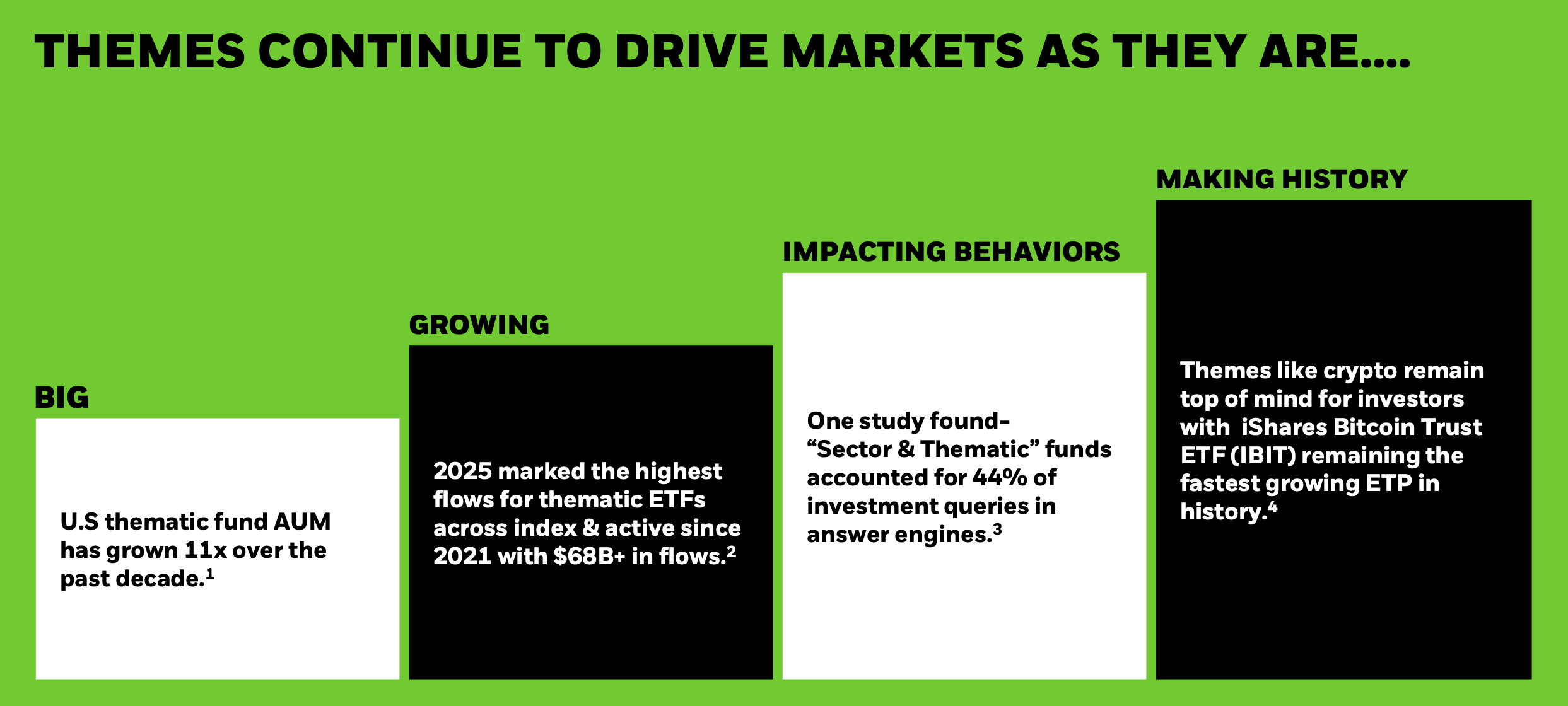
Turns out AUM invested in thematic ETF’s have grown 11x over the past decade.
In 2025 investors invested $68 billion into thematic funds.
And if you aren’t sure which themes to invest in BlackRock invented an ETF to help you.
THRO: Ishares US Thematic Rotation Active ETF.
Because you know. Investing in themes is a theme.
Charles Schwab also has thematic funds for you. Every one does.

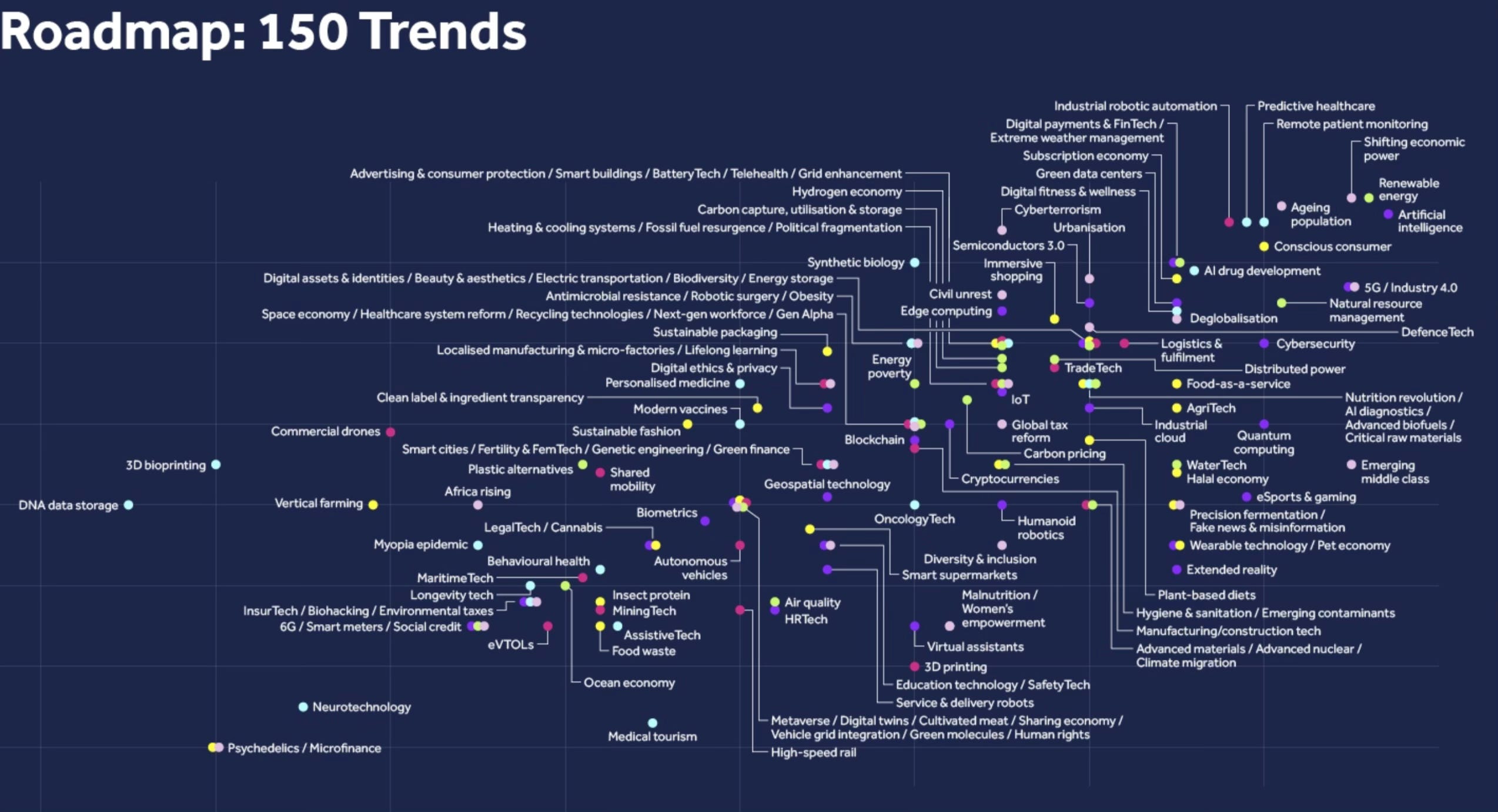
Barclays has a Roadmap of 150 themes you can choose from.
Themes as a shortcut
The love of themes is understandable. Themes serve a useful purpose. Financial markets are overloaded with information on thousands of companies. Where do you start? It’s too much. So themes are a filtering mechanism. It gives you a framework to make generalisations about sectors and industries without having to do detailed models on everything. A theme simplifies a broader concept and makes it easier to discuss. For example, say ‘K-shaped economy’ and everyone knows what you mean even though there a lot of economic assumptions associated with that concept.
Figure out a theme and you can quickly find 5 companies which should do more or less what you want. Or, just buy the ETF, which is why All Roads Lead to BlackRock. Buy enough thematic beta and the stock specific risk melts away. It’s a quick way to build a portfolio.
But there is also a mental laziness to thematic investing. And memes. Sometimes the devil, or the gold, is in the details.
Maybe I’m old fashioned, but I see less and less work on the nuances of the businesses themselves in these themes. Is this business a good business through the cycle? Are there moats? Is it a hedgehog? Are there subtle competitive advantages the company is building. Can it gain market share and work even if the theme disappoints?
There are also generally no earnings modelling in these discussions. And minimal valuation work other than the FY1 P/E.
In a way it’s a continuation of the death of active management.
Do you remember the nerdy buyside analyst from the 1990’s? Deep in his models obsessed about finding ‘great companies’? I remember them perfectly. I remember the IC stock pitches with models and peer comparisons. Highly detailed discussions about the industry and whether we should own stock A or B, or maybe C. And of course lots of talk about management and the last time we met them.
Now we laugh at that. Nobody cares about earnings models anymore.
Instead we weigh the pros and cons of:
Gold vs Crypto, Software vs Hardware, AI, Hyperscalers, Memory, Taiwan, South Korea, Critical Metals, Robotics, EV’s, Distributed Power, Quantum, Green Finance, Payments, Datacenters, Electricity, Autonomous Driving, Biotech, Strong Dollar plays, Weak Dollar plays, EM, DM, Space, Edge computing and on and on.
We want to catch waves, not invest in companies. Catch a big enough wave and company fundamentals don’t matter. All the boats float. And better to own several boats so you make sure you don’t miss the trend because you picked the wrong company.
The worst thing is to be that naive moron talking about their ‘good company with good management’ value trap stock which goes nowhere, while every optical connector stock moons it 400%.
But could we be reaching peak thematicity?
In the midst of the madness is the opportunity, counterintuitively, to own single stocks with no-theme?
Is the hot new theme ‘The No—Theme Stock’?
It reminds me of my own rule of thumb. I love going to investing conferences, but I’ve also learned that as soon as there is a conference around a theme, it is already mostly done. The good ideas don’t have conferences yet.
So potentially we want the stocks with no-theme. Or not yet.
We want to find that one-off great company which doesn’t fit into any theme, doesn’t provide any perspective about the world, but is a good business at a reasonable price.
Where do we start?
The YWR QARV Data App.
